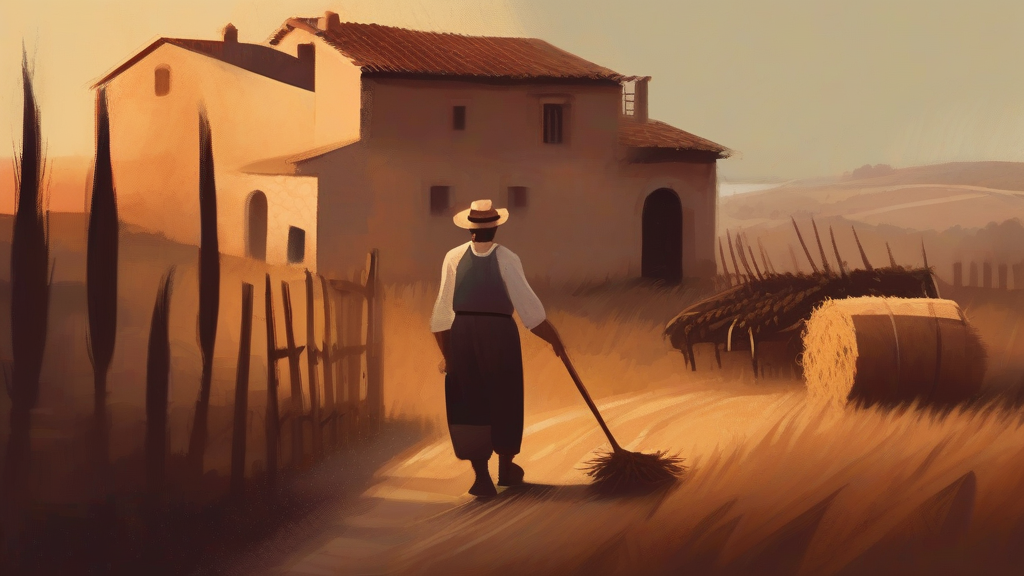
What does contadino mean?
Contadino is the Italian word for a peasant or smallholder farmer, and it has entered English mainly through writing about Italian culture and cuisine. A contadino is traditionally a country laborer who works the land, often on a modest family plot, and the term evokes the rhythms of rural life: seasonal work, simple meals, and close ties to the soil. In food writing, the adjective form — contadino or contadina, as in zuppa alla contadina — signals a rustic, farmhouse style of cooking built on humble ingredients like beans, bread, garden vegetables, and olive oil, without refinement or elaborate technique. The word derives from Late Latin 'comitatinus', meaning one who lives on a count's estate, connecting it to the words 'count' and 'county'. In English usage it carries warm connotations of authenticity and tradition rather than hardship, which is why chefs and travel writers reach for it when they want to evoke the honest flavors of the Italian countryside.
An Italian peasant or smallholder farmer; a rural laborer who works the land.
"His grandfather was a contadino in Tuscany who grew olives and kept a few sheep."
Used in English mainly in contexts concerning Italian rural life, history, or cuisine; plural contadini, feminine contadina.
Describing a dish or style that is rustic and characteristic of the Italian countryside, typically using simple farm ingredients.
"The waiter recommended the tagliatelle alla contadina, rich with mushrooms and pancetta."
Usually encountered as part of the phrase 'alla contadina' ('in the peasant style') on menus and in cookbooks.
For multiple farmers use 'contadini'; the singular feminine form is 'contadina' and its plural is 'contadine'.
"The fresco shows a group of contadini bringing in the harvest."
Every time you order a rustic Italian bean soup, you're tasting the word for farmer — contadino literally means someone who lives 'with the count'.
Reviewed by Deb Chak, Editor. AI-assisted content curated by RJS Tech Solutions LLP.
Etymology of contadino
Contadino comes from Italian, tracing back to Late Latin 'comitatinus', meaning an inhabitant of a count's lands — hence a person who lived and worked on a comitatus, the territory of a count. This makes it a direct relative of the English words 'count', 'county', and 'companion' (from Latin 'comes', companion, the title of a count). The word has long denoted the Italian peasant farmer, and its feminine form contadina and plural contadini are used alongside it.
Related word forms
How contadino is actually used
In English, contadino appears almost exclusively in writing about Italy — art history, travel literature, and especially food writing, where 'alla contadina' or 'contadina' signals a rustic, peasant-style preparation. The feminine form is contadina and the plural is contadini. The word carries connotations of simplicity, hard work, and traditional rural life rather than poverty or backwardness.
Easily confused with contadino
Campesino is the Spanish equivalent for a peasant farmer, whereas contadino is the Italian term.