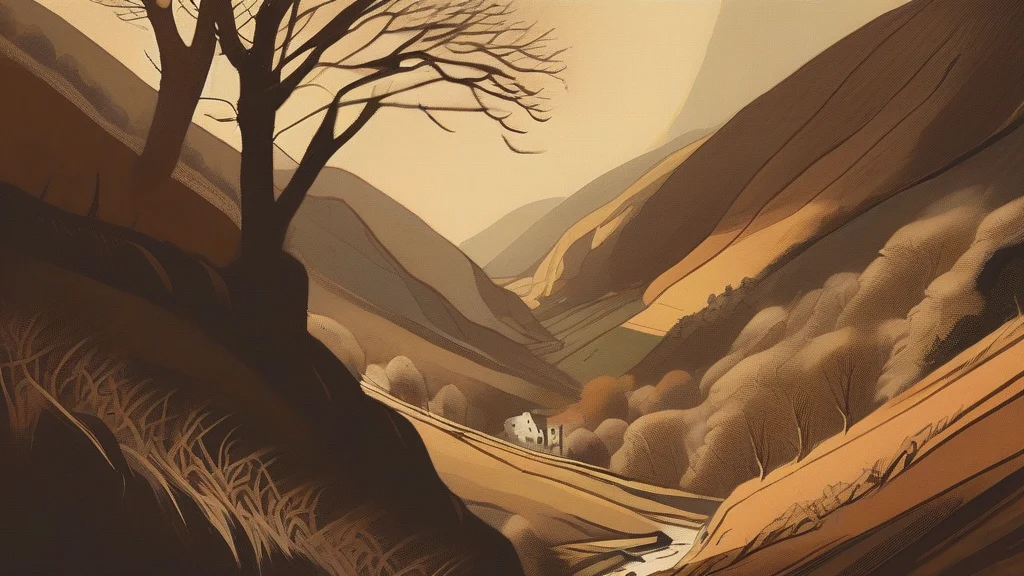
What does coombe mean?
A coombe is a small, steep-sided valley or deep hollow cut into a hillside, a term used almost exclusively in British English and particularly associated with the counties of South West England such as Devon, Dorset, and Somerset. The word is closely tied to the landscape of chalk downs and coastal hillsides, where streams have carved short, sheltered valleys that are often wooded or grassy. Because so many English settlements grew up in these valleys, "coombe" appears frequently in place names — sometimes as part of a town's very name. The spelling is unstable, with "combe," "coomb," and "cwm" (the Welsh cognate) all encountered. In literature and nature writing, the word evokes an intimate, enclosed pastoral scene: a hidden dell where sheep graze out of the wind or a footpath drops toward the sea. For readers interested in topography, dialect, or the way language records landscape, "coombe" is a quietly distinctive term.
nounA steep-sided, narrow valley or hollow on the side of a hill, especially in South West England; a deep wooded dell.
- A narrow, steep-sided valley or deep hollow in a hillside.
- (In place names, often prefixed by a personal name or descriptor) A settlement or feature located in such a valley.
"The footpath wound down through the shaded coombe to the sea."
"Sheep grazed on the grassy slopes of the coombe, sheltered from the wind."
"They rented a cottage at the head of a wooded coombe a mile from the coast."
The plural follows the regular English pattern and is used chiefly in descriptions of landscape, as in accounts of the chalk country of southern England.
"The downland is scored with coombes, each one hiding its own patch of woodland."
Walk through Devon or Dorset and you'll keep tripping over this word — it's carved into dozens of place names like Salcombe and Compton, because the landscape itself is made of coombes.
Reviewed by Deb Chak, Editor. AI-assisted content curated by RJS Tech Solutions LLP.
Etymology of coombe
Coombe derives from Old English "cumb," meaning a bowl-shaped valley or hollow, which itself was likely borrowed from a Brittonic Celtic source. Its closest relative is Welsh "cwm," meaning exactly the same thing — a steep-sided valley — showing how deeply the term is rooted in the ancient languages of Britain. The spelling has fluctuated over centuries among forms such as "combe," "coomb," and "coombe," with the last surviving mainly in West Country usage and place names.
How coombe is actually used
Chiefly British, and strongly associated with the chalk downlands of southern England and the countryside of Devon, Dorset, and Somerset. The word carries a rural, pastoral connotation and appears most often in regional writing, natural-history prose, and place names rather than everyday speech. Spelling varies widely between "coombe," "combe," and "coomb."
Easily confused with coombe
"Combe" is the more widespread spelling of the same word for a small valley, while "coombe" is the form chiefly used in Devon and Dorset place names.
"Coomb" is simply another spelling variant of the same valley word and carries no separate meaning.