What does coppersmith mean?
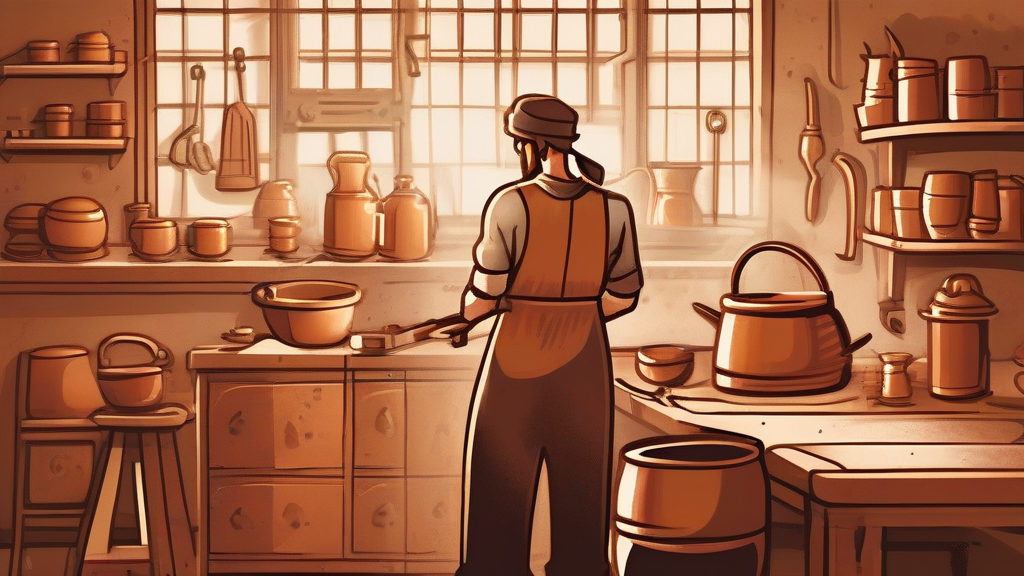
A coppersmith is a metalworker who specialises in shaping and repairing articles made of copper. Using hammers, anvils, and heat, coppersmiths have traditionally produced household and practical goods such as pots, pans, kettles, jugs, and utensils, as well as decorative items like vases and ornamental panels. The word is a simple compound of 'copper', the reddish-brown metal, and 'smith', an old English term for a worker in metal. Coppersmithing is one of the oldest metalworking trades, since copper is soft, malleable, and among the first metals humans learned to work. Although industrial manufacturing has reduced demand for hand-crafted copperware, the trade survives among artisans who restore antique cookware or produce bespoke pieces, and the word retains a warm, traditional connotation of skilled manual craftsmanship. It appears most often in historical writing, descriptions of traditional markets, and discussions of heritage crafts.
nounA person whose trade is making and repairing articles from copper, such as pots, pans, and utensils, by hammering and shaping the metal.
- A craftsman who makes and repairs articles made of copper.
"The village coppersmith still hammers out copper kettles by hand in his workshop near the square."
"Apprenticed at fourteen, he became a master coppersmith known for his finely hammered bowls."
"In the old bazaar, the rhythmic tapping of the coppersmith's mallet echoed down the lane."
Standard regular plural; used when referring to multiple practitioners of the trade.
"The guild of coppersmiths was among the oldest in the city."
The coppersmith's hammer has shaped everything from ancient temple vessels to the copper bottoms of modern saucepans — a craft over five thousand years old that is still alive today.
Reviewed by Deb Chak, Editor. AI-assisted content curated by RJS Tech Solutions LLP.
Etymology of coppersmith
The word 'coppersmith' combines 'copper', which entered Middle English from Old English 'copor', likely borrowed from Late Latin 'cuprum', a contraction of 'aes Cyprium' meaning 'metal of Cyprus', where the Romans mined much of their copper; and 'smith', from Old English 'smið', meaning a worker in metal. As a compound it denotes a smith who works specifically in copper, paralleling terms like 'blacksmith' and 'goldsmith'. Such occupational compounds developed naturally in Germanic languages, and cognate formations exist in other Germanic tongues.
How coppersmith is actually used
The word is a straightforward compound of 'copper' + 'smith'. It is a neutral, somewhat traditional term; the trade itself is now relatively rare, so the word often appears in historical or artisanal contexts. The plural is 'coppersmiths'.
Easily confused with coppersmith
A blacksmith works primarily with iron and steel, whereas a coppersmith specializes in copper.
A silversmith crafts objects from silver, often decorative or fine tableware, while a coppersmith works with copper, typically utilitarian items.