What does cordwood mean?
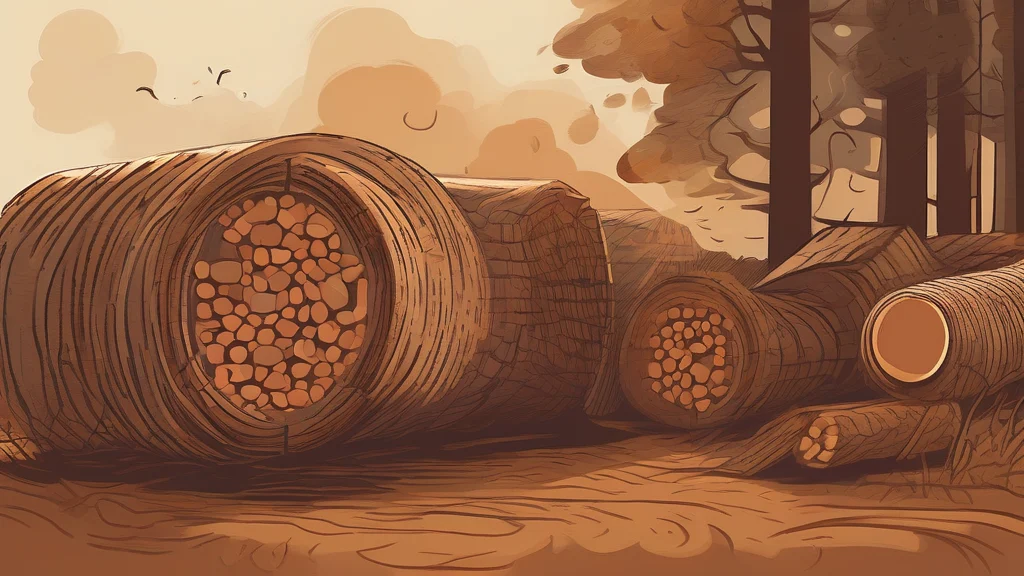
Cordwood is wood that has been sawn into short, standardized lengths—historically around sixteen inches, roughly four feet long pieces being split and stacked—so that it burns efficiently in fireplaces, stoves, or furnaces. The name reflects its traditional unit of sale, the cord, a stacked volume of 128 cubic feet measuring four by four by eight feet. As a mass noun used almost exclusively in the singular, cordwood evokes practicality and self-sufficiency: it is the language of farmsteads, woodsheds, and winter preparations. The word also survives figuratively in the expression "stacked like cordwood," describing anything laid in tight, orderly rows, a phrase so evocative that it has been applied to everything from harvested timber to casualties in war reporting. Though central heating has reduced everyday reliance on wood fuel, cordwood remains a common term in rural life, among homesteaders, and in discussions of sustainable heating, making it both a useful household word and a small window into the economics of pre-industrial life.
nounWood that has been cut into short, uniform lengths (typically about 16 inches / 40 cm) suitable for burning in a fireplace or stove, especially when stacked for storage or sale.
- Wood cut into short, uniform lengths for use as fuel, especially when measured or sold by the cord.
"The farmer spent the last week of September cutting and stacking cordwood before the first frost."
"The delivery truck backed up the driveway and unloaded a full cord of seasoned cordwood beside the barn."
"In colonial New England, a family might burn through twenty cords of cordwood over a single harsh winter."
Rarely used; cordwood is conventionally treated as a mass noun and left unpluralized even when referring to multiple cords.
"Several stacks of cordwood lined the north wall of the barn."
"Stacked like cordwood" is such a vivid image of tight, orderly packing that soldiers and disaster reporters have borrowed it for centuries to describe rows of anything — even bodies.
Reviewed by Deb Chak, Editor. AI-assisted content curated by RJS Tech Solutions LLP.
Etymology of cordwood
Cordwood is an English compound of two native Germanic elements: "cord," ultimately from Latin chorda meaning string or rope (itself from Greek khordē), and "wood," from Old English wudu. The compound arose because firewood was historically sold by the cord—a stack measuring four feet high, four feet wide, and eight feet long—and the wood was cut to lengths that would fit such a stack neatly. The word has been established in English since at least the early seventeenth century, and its relatives include other uses of "cord" such as cordon and accord, all tracing back through Old French corde to the same Latin root.
How cordwood is actually used
Cordwood is almost always treated as a mass noun; the plural "cordwoods" is rare and generally unnecessary. It carries a rustic, practical connotation and appears most often in rural, historical, or homesteading contexts rather than formal prose.
Easily confused with cordwood
A chord is a musical harmony of several notes or a straight line joining two points on a curve, whereas cordwood is firewood cut into short lengths; the shared 'cord' element comes from different applications of the same word.
Firewood is any wood burned as fuel in whatever form it takes, while cordwood specifically refers to wood cut into standard uniform lengths, traditionally measured by the cord.