What does driftwood mean?
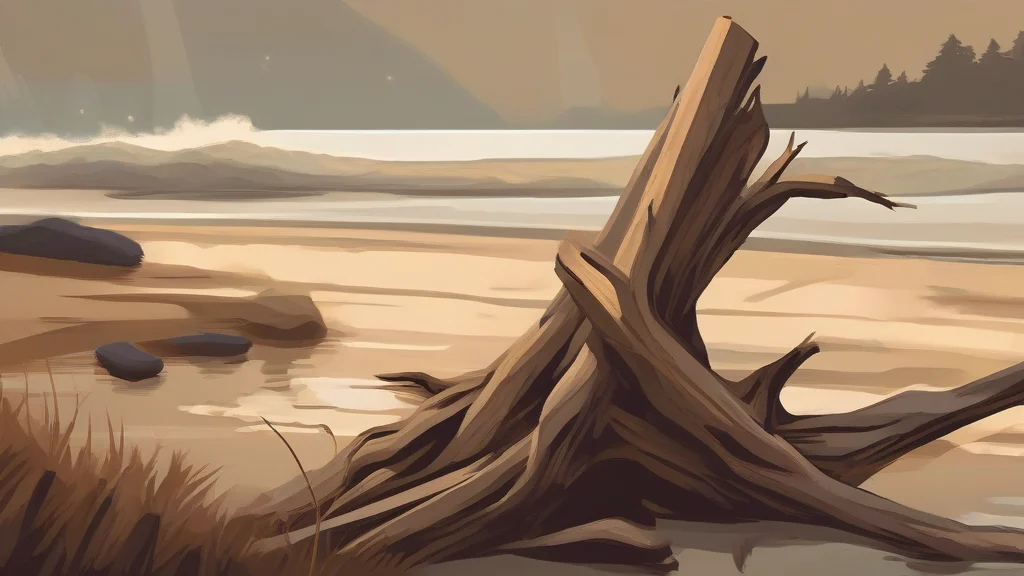
Driftwood is wood that floats in the sea, a lake, or a river, or that washes up onto shores after being carried there by currents, tides, or storms. Typically stripped of bark, smoothed, and bleached pale grey by salt water and sun, it accumulates on beaches around the world and can travel enormous distances on ocean currents before coming ashore. Beyond its literal sense, driftwood is prized as a raw material: sculptors, furniture makers, and hobbyists value its weathered texture and organic shapes for tables, mirrors, wall art, and garden ornaments. The word functions as an uncountable noun, usually taking singular agreement, with phrases like 'pieces of driftwood' used to count individual fragments. Figuratively, driftwood sometimes evokes aimlessness or something carried passively by circumstance. It is a familiar word in coastal regions and a popular one in design and craft contexts, where its rustic, sun-bleached aesthetic remains enduringly fashionable.
Wood that is floating in water or has been deposited on a shore by waves, tides, or currents.
"The incoming tide pushed fresh driftwood high onto the sand."
Usually treated as an uncountable mass noun; count individual items with phrases like 'pieces of driftwood'.
Weathered, water-borne wood used as a material for making furniture, sculptures, or decorative objects.
"The artisan sells lamps made entirely from local driftwood."
Driftwood has no standard plural form because it is an uncountable mass noun. When referring to multiple items, use constructions such as 'pieces of driftwood' or 'several bits of driftwood'. A rare plural 'driftwoods' occasionally appears when distinguishing different collections or types of driftwood, but this is nonstandard.
"After the storm, pieces of driftwood lay tangled across the entire beach."
Every piece of driftwood on a beach has its own untold voyage — some logs ride ocean currents for decades and thousands of miles before finally washing ashore.
Reviewed by Deb Chak, Editor. AI-assisted content curated by RJS Tech Solutions LLP.
Etymology of driftwood
Driftwood is a straightforward English compound formed from 'drift', meaning to be carried slowly by wind or water, and 'wood'. The verb 'drift' comes from Middle English 'driften', which derives from Old English 'drīfan', meaning to drive or push forward, a word shared with other Germanic languages. The compound has been in use since at least the early modern period to describe timber borne along by rivers or seas.
How driftwood is actually used
Driftwood is an uncountable noun in most contexts, taking singular agreement ('the driftwood was scattered along the shore'); 'pieces' or 'bits of driftwood' are used when counting individual items. The word often carries connotations of weathering, patience, and natural beauty, and it appears frequently in coastal, artistic, and metaphorical writing.
Easily confused with driftwood
Flotsam refers specifically to goods or debris floating on the water's surface (traditionally from a shipwreck), whereas driftwood is any wood drifting in water or washed ashore.