What does cornelian mean?
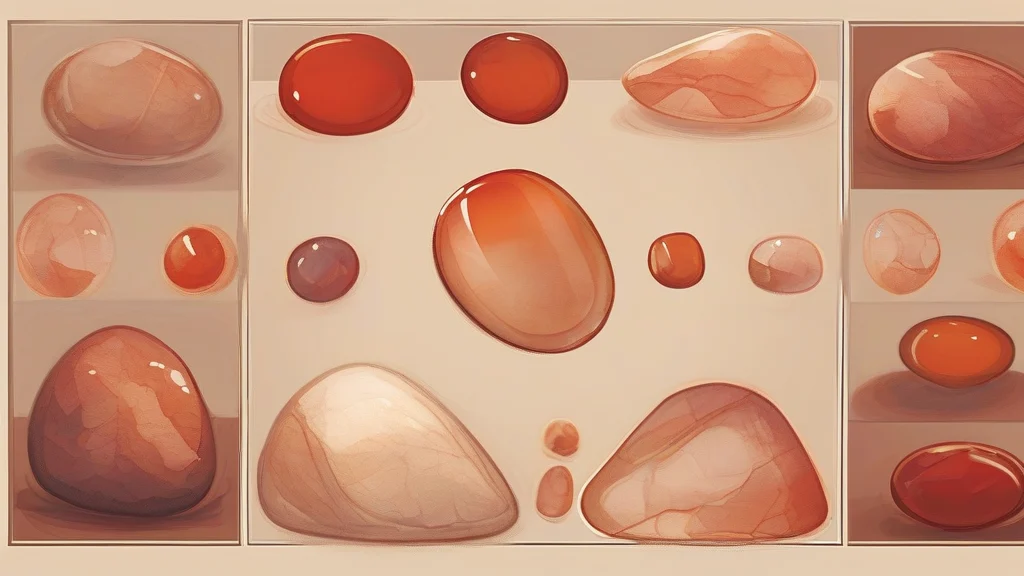
Cornelian is a semiprecious gemstone: a translucent to opaque variety of chalcedony quartz prized for its warm shades of orange and red, ranging from pale flesh tones to deep brick. It has been worked by craftspeople since ancient times, appearing in Egyptian amulets, Roman signet rings, and Mesopotamian cylinder seals, because it takes a fine polish and is hard enough to hold engraved detail while soft enough to carve. The name has long been associated either with the flesh-red colour of the stone or with its horn-like translucence, and it survives today chiefly in two spellings, 'carnelian' and 'cornelian', which refer to exactly the same mineral. In modern usage the word turns up mainly in descriptions of antique jewellery, archaeology, and lapidary work, where it evokes warmth, durability, and a direct link to ancient ornament.
nounA semi-precious gemstone, a reddish-orange variety of chalcedony, often used for seals, beads, and jewellery; a variant spelling of 'carnelian'.
- A reddish-orange variety of chalcedony used as a semiprecious stone in seals, beads, and jewellery.
"The signet ring was carved from a single polished cornelian."
"She wore a simple pendant of banded cornelian against her throat."
"Ancient Mesopotamian seals, cut from cornelian, have survived four thousand years with their designs intact."
Regular plural; typically used when referring to multiple stones or set gems.
"The necklace was strung with small polished cornelians."
Napoleon's lucky charm was a cornelian seal he reportedly lost the day before Waterloo.
Reviewed by Deb Chak, Editor. AI-assisted content curated by RJS Tech Solutions LLP.
Etymology of cornelian
The word entered English in the early fifteenth century as 'corneline' and was later remodelled into the forms 'carnelian' and 'cornelian'. Its ultimate origin lies in Latin: one line of derivation points to 'carneus', meaning flesh-coloured, describing the stone's hue, while another links it to 'corneus', made of horn, a reference to the stone's translucency — this latter root, Latin 'cornu' meaning horn, also gives us 'unicorn', 'cornet', and 'cornucopia'. Both spellings have coexisted for centuries and denote the same gemstone.
How cornelian is actually used
'Cornelian' is an accepted but less common variant of the standard spelling 'carnelian'; both refer to the same stone. The word carries connotations of antiquity and warmth and appears mostly in contexts of jewellery, archaeology, and decorative arts rather than everyday speech.
Easily confused with cornelian
A chameleon is a colour-changing lizard, while cornelian (despite the similar ending) is a red-orange semiprecious stone.