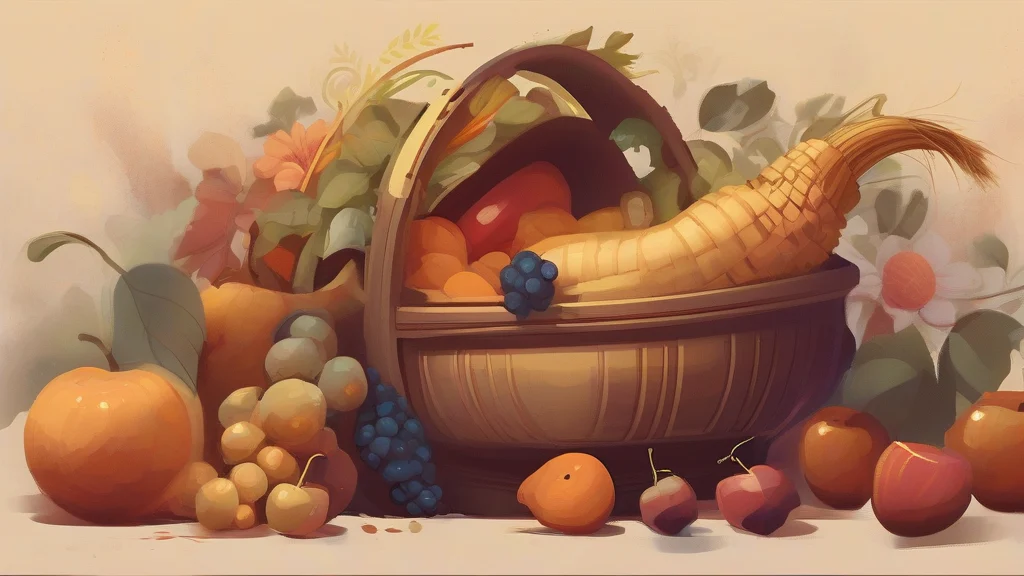
What does cornucopia mean?
A cornucopia is a symbol and a metaphor of overflowing abundance. In its original, concrete sense it is a curved, horn-shaped basket brimming with fruits, vegetables, and flowers — a familiar centerpiece of Thanksgiving decorations and harvest imagery in North America. Far more often today, the word is used figuratively to mean a rich, plentiful, or seemingly inexhaustible supply of something: 'a cornucopia of options', 'a cornucopia of talent'. The word carries warm, positive connotations of generosity, fertility, and good fortune, which is why advertisers, travel writers, and journalists reach for it when they want to convey lavishness without sounding crass. It entered English in the early seventeenth century from Late Latin, itself borrowed from Greek, where mythology told of a magical horn that produced endless food and drink. Whether describing a holiday table groaning with dishes or a database packed with information, cornucopia remains one of English's most vivid ways to say 'more than enough'.
nounA horn-shaped container overflowing with fruits, flowers, or other produce, symbolizing abundance and plenty; more broadly, an overflowing supply or profusion of desirable things.
- A decorative horn-shaped container overflowing with fruit, flowers, or grain, used as a traditional emblem of abundance, especially at Thanksgiving.
- An abundant or seemingly inexhaustible supply of something good — food, choices, opportunities, information.
"The harvest festival table was a veritable cornucopia of autumn produce."
"The market stall was a cornucopia of ripe peaches, figs, and late-summer tomatoes."
"The internet has given researchers a cornucopia of primary sources that were once nearly impossible to access."
The standard plural simply adds '-s'; the Latinate plural 'cornuacopiae' is not used in English.
"The craft fair stalls displayed cornucopias of every size, woven from wicker and dried wheat."
The cornucopia comes straight from Greek myth — Zeus accidentally broke off a goat's horn, and it magically filled with whatever its owner wished for.
Reviewed by Deb Chak, Editor. AI-assisted content curated by RJS Tech Solutions LLP.
Etymology of cornucopia
Cornucopia derives from the Late Latin 'cornu copiae', meaning 'horn of plenty', formed from Latin 'cornu' (horn) and 'copia' (abundance). The Latin term translates the earlier Greek 'keras Amaltheias', the horn of the goat Amalthea who suckled the infant Zeus in Greek mythology. English adopted the word in the early seventeenth century, and both elements of the compound live on elsewhere: 'cornu' also gives us words like unicorn and cornea, while 'copia' underlies copious and related terms.
How cornucopia is actually used
Cornucopia is slightly formal or literary in register but common enough for general use, especially in journalism and advertising. It is almost always followed by 'of' plus a noun phrase ('a cornucopia of delights'). The literal horn sense is now largely confined to seasonal decoration, while the figurative 'abundance' sense dominates modern usage. The connotation is overwhelmingly positive, suggesting generosity and richness rather than mere excess.
Easily confused with cornucopia
Concordia is the Roman goddess (or Latin word) of harmony and agreement, whereas a cornucopia is a horn of plenty symbolizing abundance.