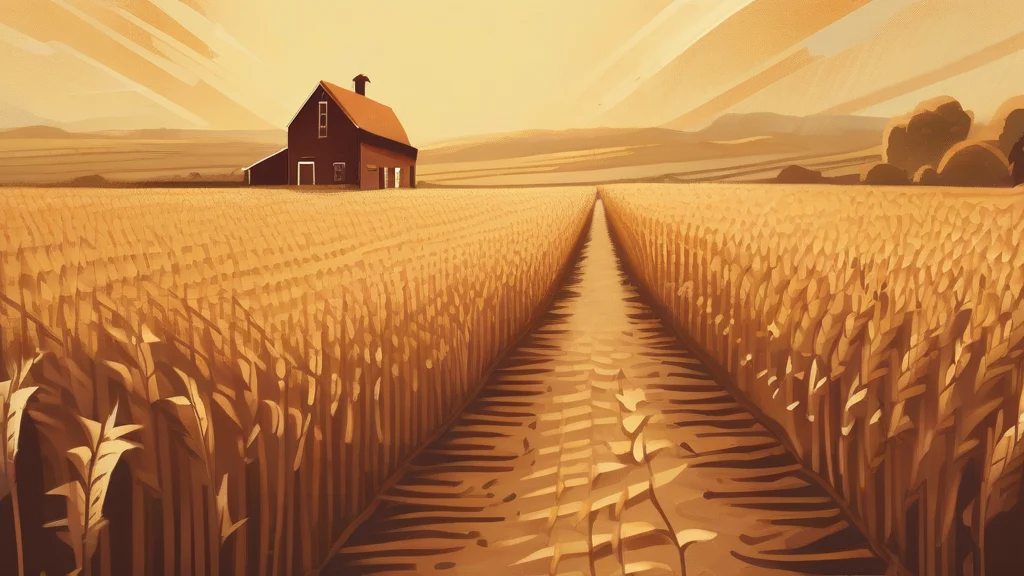
What does cornfield mean?
A cornfield is a field devoted to growing cereal crops — most specifically maize in American English, but in British English the term traditionally covers whichever grain dominates local agriculture, such as wheat, barley, oats, or rye. The word is a straightforward compound of 'corn' and 'field', yet its meaning varies meaningfully across the Atlantic because 'corn' itself carries different senses in different regions. Cornfields are among the most iconic images of rural landscape: tall green rows in midsummer that turn gold at harvest, evoking fertility, abundance, and the rhythms of agricultural life. They appear constantly in literature, painting, and everyday speech, and the word carries warm, pastoral connotations rather than technical ones. For anyone describing farming, countryside scenery, or food production, 'cornfield' is an essential and vivid term whose regional nuances are worth keeping in mind when writing for an international audience.
nounA field in which corn or another cereal crop, such as wheat or barley, is grown.
- A field planted with maize (corn), especially in American usage.
- More broadly, any field of standing cereal grain such as wheat, rye, oats, or barley, as commonly understood in British usage.
"The hikers paused at the edge of the cornfield to watch the sun sink behind the swaying stalks."
"A scarecrow stood guard over the ripening cornfield."
"The painting depicted golden cornfields stretching to the horizon under a summer sky."
The standard plural follows regular English noun pluralization and is common when describing landscapes containing several such fields.
"From the hilltop we could see patchwork cornfields stretching across the valley."
In Britain, a 'cornfield' might hold no maize at all — 'corn' there traditionally means whatever grain is the region's staple, usually wheat or barley.
Reviewed by Deb Chak, Editor. AI-assisted content curated by RJS Tech Solutions LLP.
Etymology of cornfield
Cornfield is a compound of 'corn' and 'field', both ancient words of Old English origin. 'Corn' derives from Old English 'corn', which originally meant any small hard grain or seed and was applied to the principal cereal crop of a region — a sense still preserved in British usage; it is cognate with Dutch 'koren' and German 'Korn'. 'Field' comes from Old English 'feld', meaning open or cultivated land. The compound itself arose naturally within English to describe land sown with grain, with the specific sense shifting toward maize in North America after European colonization.
How cornfield is actually used
The word's meaning shifts by geography: in North America it almost always implies maize, while in British and Irish usage 'corn' historically refers to the dominant local cereal, so a cornfield may be wheat or barley. It is a neutral, everyday word with strong pastoral and rural connotations, common in landscape description, agriculture, and literature.