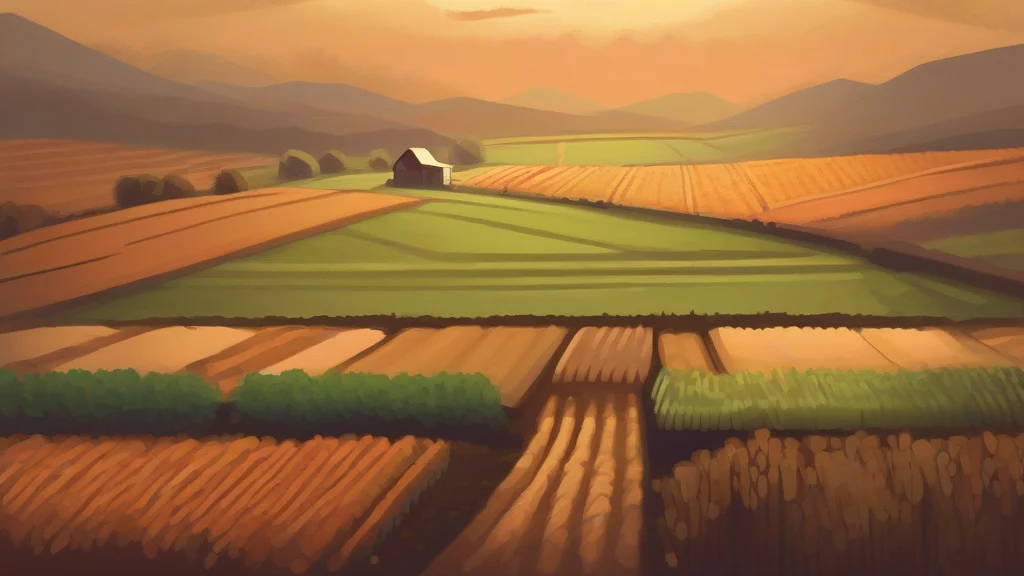
What does cropland mean?
Cropland is land that is deliberately cultivated to grow crops — grains, vegetables, fruits, oilseeds, and other agricultural products. The term belongs primarily to the vocabulary of agriculture, geography, environmental policy, and official statistics, where it serves as a precise counterpoint to related categories such as pasture, rangeland, and forest: cropland is specifically tilled or planted for harvestable produce, not grazed by livestock. In common usage it functions as an uncountable noun ('millions of acres of cropland'), although the plural 'croplands' occurs when writers distinguish separate regions of cultivation. Because fertile soil is a finite resource, the word frequently carries weight in debates about urban expansion, soil degradation, and food security — phrases like 'prime cropland' or 'loss of cropland' signal concern over irreplaceable agricultural capacity. For anyone reading reports on farming or land use, understanding this term is essential to interpreting how humanity allocates its most productive ground.
nounLand that is used for growing crops, especially cultivated farmland on which food or other agricultural products are raised.
- Land cultivated for the production of crops such as grains, vegetables, fruits, and oilseeds.
- (In land-use classification) A category of agricultural land distinguished from pasture, forest, and developed areas.
"The new irrigation scheme transformed thousands of hectares of arid ground into productive cropland."
"Fertile cropland in the river valley has been farmed by the same families for generations."
"Urban sprawl continues to consume valuable cropland at an alarming rate."
Cropland is typically used as an uncountable noun. The plural 'croplands' appears mainly in geographic or descriptive writing to refer to several distinct regions or tracts of crop-producing land.
"The prairie croplands of North America are among the most productive grain-growing regions in the world."
Roughly half of the world's habitable land has been converted into cropland — more than any other single human use of the planet's surface.
Reviewed by Deb Chak, Editor. AI-assisted content curated by RJS Tech Solutions LLP.
Etymology of cropland
Cropland is a compound formed from two native English words: 'crop', meaning cultivated plants harvested for use, and 'land'. Both elements trace back through Old English — 'crop' to Old English 'cropp' (the sprout or head of a plant) and 'land' to Old English 'land' — making cropland a thoroughly Germanic formation rather than a borrowing from Latin or French. As an explicit compound it is comparatively recent, gaining currency in modern agricultural, statistical, and policy contexts as land-use classification became formalized in the nineteenth and twentieth centuries.
How cropland is actually used
Cropland is used chiefly in formal, technical, and policy contexts — agriculture, geography, environmental science, and government statistics — rather than everyday conversation. It is often treated as an uncountable mass noun, though the plural 'croplands' appears when referring to multiple distinct regions or tracts of crop-growing land.
Easily confused with cropland
Farmland is a broader term covering all agricultural land, including pasture and grazing land for livestock, whereas cropland refers specifically to land used for growing crops.
Grassland is land dominated by grasses, typically used as pasture or rangeland rather than for cultivating crops.