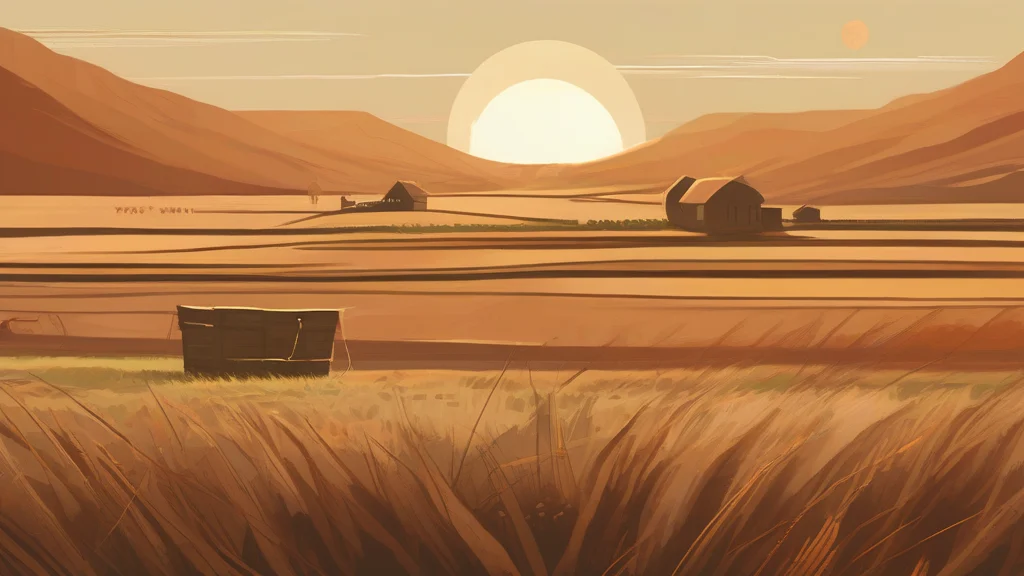
What does field mean?
"Field" is one of English's most versatile nouns. Its core sense is an expanse of open land — ploughed for crops, sown with grass, or left to grazing animals — a meaning rooted in centuries of rural life. From this concrete origin, the word broadened metaphorically: a field became any arena of activity or expertise, so we speak of the field of law, politics, or medicine, and of being a leader "in the field." In physics, a field names the invisible region where a force like gravity or magnetism operates, while in sport it denotes both the playing surface and the team defending it. As a verb, to field something means to catch a ball, or figuratively to handle questions or complaints with skill. Derived terms such as fieldwork and fielder extend the family further. Few words move so naturally between farm, laboratory, stadium, and office, making "field" essential vocabulary across registers.
An area of open land, typically devoted to crops or pasture; also a branch of study or activity, a physical force region, or a data element within a record.
"Farmers harvested wheat from the eastern field before the rain arrived."
The abstract senses ('a field of research', 'magnetic field') dominate formal and technical writing, while the agricultural sense dominates everyday speech.
To catch or return a ball in play; to put a team or player onto the pitch; or figuratively, to deal with questions, calls, or complaints.
"The minister fielded hostile questions during the televised debate."
The figurative use ('field questions') implies calm competence rather than avoidance.
Standard regular plural; common in both literal (agricultural) and figurative (academic domains) contexts.
"Golden fields stretched toward the horizon in every direction."
The word 'field' is over a thousand years old and appears in place names across England — but its oldest English cousin, the South African 'veld', still covers vast plains today.
Reviewed by Deb Chak, Editor. AI-assisted content curated by RJS Tech Solutions LLP.
Etymology of field
"Field" derives from Old English "feld", meaning open or cultivated land, and is cognate with Old Frisian "feld", Old Saxon and Dutch "veld", and Old High German "felt". All trace back to Proto-Germanic "*felþuz". The Germanic root may ultimately connect to a broader Indo-European base related to flatness or cleared ground, though this deeper origin is uncertain. The South African term "veld", borrowed from Afrikaans, preserves the same root, and "feldspar" (from German) also contains it, literally meaning "field spar".
Related word forms
How field is actually used
Highly versatile across registers: agricultural senses are everyday and neutral; academic and scientific senses ('the field of genetics', 'magnetic field') appear in formal writing. As a verb, 'field questions' carries a slightly informal, journalistic tone suggesting quick, composed handling.
Easily confused with field
"Filed" is the past tense of "file" (to organize or submit documents), while "field" refers to an area of land, a subject area, or, as a verb, to handle or deal with something.