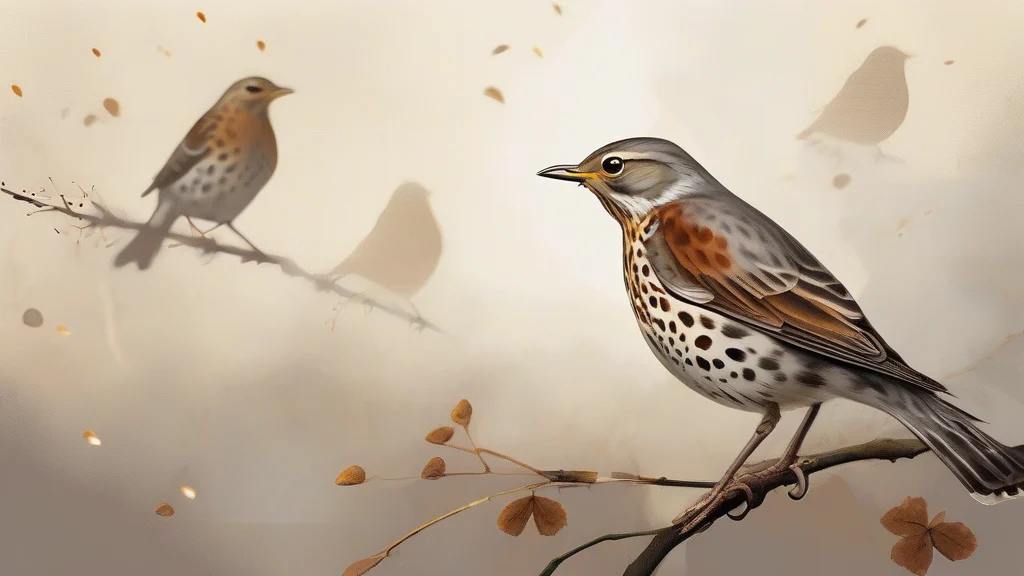
What does fieldfare mean?
The fieldfare is a large member of the thrush family, Turdus pilaris, breeding across northern Europe and Asia and migrating south-west in winter, when great numbers arrive in Britain and western Europe. It is instantly recognisable by its blue-grey head and rump, warm chestnut back, and breast boldly spotted with black on a pale ground — a pattern somewhat like that of the mistle thrush, though its build and colouring set it apart. Fieldfares are strongly social birds, travelling and feeding in loose, chattering flocks that descend on hedgerows, orchards, and berry-laden shrubs during cold weather, and their harsh 'chack' calls carry across fields as they move. The name is ancient, dating back to Old English, and translates roughly as 'traveller of the fields', a nod both to the bird's habitat and its wandering habits. For birdwatchers, the arrival of fieldfares each autumn is one of the clear markers of the changing season, making the word a staple of naturalist writing rather than everyday conversation.
nounA large migratory thrush (Turdus pilaris) of Europe and Asia, with grey head and rump, chestnut back, and spotted breast, often seen in flocks in winter feeding on berries in fields and hedgerows.
- A large European and Asian thrush (Turdus pilaris) with a grey head and rump, chestnut mantle, and spotted breast, noted for forming noisy winter flocks that feed on berries and invertebrates in open countryside.
"In the hard January frost, flocks of fieldfares descended on the hedgerows to strip the haws."
"A chattering flock of fieldfares swept across the frozen orchard in search of leftover apples."
"The fieldfare's harsh 'chack-chack' call often gives away its presence before the bird itself is seen."
A regular plural; because the bird is notably gregarious, the plural is very common in naturalist writing.
"Flocks of fieldfares arrived with the first hard frosts of November."
The fieldfare's name is over a thousand years old — it literally means 'the traveller of the fields', a compound the Anglo-Saxons coined long before modern English existed.
Reviewed by Deb Chak, Editor. AI-assisted content curated by RJS Tech Solutions LLP.
Etymology of fieldfare
The word 'fieldfare' descends from the Old English 'feldefare' (also recorded as 'fealdefare'), a compound of 'feld' ('field') and an element related to the verb 'faran', meaning 'to travel or go'. The name thus essentially means 'the field-traveller', referring to the bird's habit of foraging across open ground. The same Germanic verb 'faran' survives in modern English words such as 'fare', 'farewell', 'wayfarer', and 'thoroughfare'. The term has been applied to this same thrush continuously since the Anglo-Saxon period, making it one of the older bird names in the English language.
How fieldfare is actually used
The plural is regularly 'fieldfares'. The word is chiefly used by birdwatchers and naturalists; it carries no figurative or extended senses in modern English. Because the bird is Eurasian, the term arises mostly in British (and other European) English contexts, particularly in discussions of migrating or overwintering birds.
Easily confused with fieldfare
The redwing is another winter-visiting British thrush, but it is smaller, with a prominent cream stripe above the eye and red flanks rather than the fieldfare's grey head and rump.