
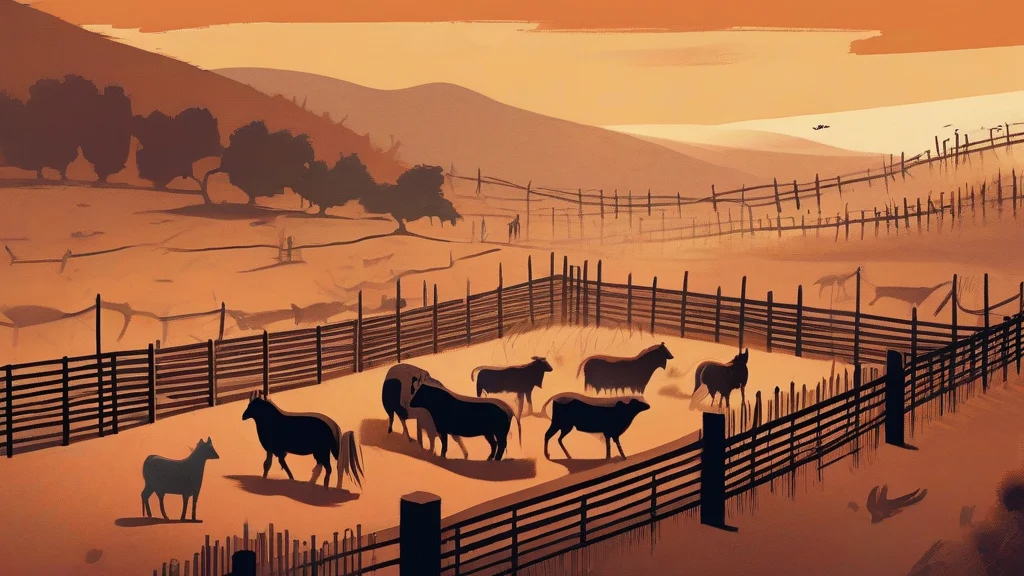
What does corralled mean?
"Corralled" is the past tense and past participle of "corral," a verb meaning to drive animals into an enclosure, or figuratively to round up and confine people, objects, or abstract things such as support or attention. The word entered English from Spanish, in which "corral" denotes a pen or yard for livestock, and it retains strong associations with the cattle-raising culture of the American West, where ranch hands corralled herds on horseback. In modern usage it appears most often in journalism and everyday speech in its extended sense: police have corralled suspects, organizers have corralled volunteers, and negotiators have corralled wavering votes. The figurative use often implies a degree of pressure or containment — those who are corralled are typically gathered somewhat against their inclination rather than by free choice. The verb remains vivid and concrete, lending writing a tactile, physical quality even when describing abstract situations.
verb (past tense and past participle of 'corral')Past tense of 'corral': to drive or gather animals into a corral or enclosure; by extension, to round up, confine, or bring people or things under control.
- (of livestock) driven or gathered into an enclosure
- (figuratively) rounded up, confined, or brought under control, as of people or things
"The cowboys corralled the stray cattle before the storm rolled in."
"The ranch hands corralled the horses at dusk."
"Reporters corralled the senator outside the courthouse for comment."
English borrowed 'corral' straight from Spanish — so every time you say someone was 'corralled,' you're speaking a little cowboy Spanish.
Reviewed by Deb Chak, Editor. AI-assisted content curated by RJS Tech Solutions LLP.
Etymology of corralled
"Corral" was borrowed from Spanish in the early 19th century during the period of westward expansion in North America, when English-speaking ranchers adopted the term for the enclosures used to hold cattle. The Spanish noun derives ultimately from Vulgar Latin *currale, meaning an enclosure for carts or animals, related to Latin currus (cart). Portuguese contributed the closely parallel form "curral," while Afrikaans "kraal" reflects the same Germanic-era borrowing chain through Dutch in southern Africa. The figurative sense of gathering or confining people developed naturally from the livestock sense.
Related word forms
How corralled is actually used
The literal sense applies to livestock handling, especially in the American West. The figurative sense — corralling people, votes, resources — is common in journalism and carries a slightly forceful connotation of being hemmed in or compelled.
Easily confused with corralled
'Choraled' relates to a chorus or choir (singing together), while 'corralled' means herded or confined like cattle in an enclosure.