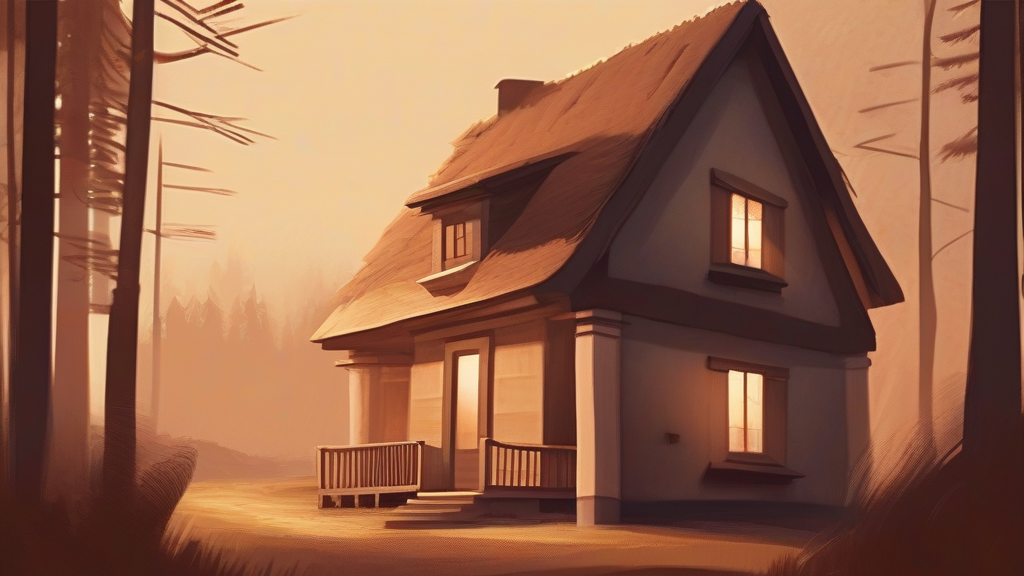
What does cottage mean?
A cottage is a small house, typically found in the countryside or a village, though the exact image the word evokes varies by region. In Britain, a cottage suggests a traditional, often centuries-old dwelling — perhaps thatched, stone-built, or rose-covered — and carries strong connotations of rustic charm and rural simplicity. In North America, the word more often refers to a modest second home used for holidays, particularly near lakes or coastal areas. Beyond architecture, 'cottage' appears in the established phrase 'cottage industry,' originally describing manufacturing carried out in workers' homes and now applied figuratively to any small-scale, home-based enterprise. The word derives ultimately from Old English 'cot', meaning a shelter or hut, via medieval Anglo-Norman French influence. Its enduring appeal lies in what it represents: comfort, modesty, and an idealized connection to rural life, making it a favourite of estate agents, travel writers, and anyone dreaming of a simpler way of living.
nounA small house, typically in a rural or semi-rural setting; in British English, also a modest country dwelling that may be historic and picturesque.
- A small house, especially one in the countryside or a village.
- (British English) A modest, often traditional or historic country dwelling, sometimes with a thatched roof.
- Figuratively, in 'cottage industry', a small-scale business or craft operated from home.
"They rented a stone cottage by the sea for the summer."
"She grew up in a whitewashed cottage at the edge of the moor."
"Beekeeping started as a cottage industry before it became big business."
Regular plural; commonly used when referring to rows or clusters of small houses, e.g. in holiday villages.
"The lane was lined with whitewashed cottages."
A 'cottage industry' once meant workers spinning wool at home — now it describes any tiny business run from a kitchen table, all thanks to this humble little word for a humble little house.
Reviewed by Deb Chak, Editor. AI-assisted content curated by RJS Tech Solutions LLP.
Etymology of cottage
The word 'cottage' entered English in the late Middle Ages (attested from around the 14th century) as 'cotage', meaning a dwelling place for a cotter — a peasant who held a cottage in return for labour. It combines the Old English root 'cot', meaning a hut or shelter (the same root seen in 'cote', as in 'dovecote'), with the French-derived suffix '-age'. The term thus reflects the medieval social order, denoting the humblest class of rural dwelling occupied by landless farm labourers.
Related word forms
How cottage is actually used
In American English, 'cottage' often suggests a simple vacation home, sometimes near a lake. In British English it carries connotations of charm, tradition, and rural idyll, and can describe surprisingly substantial dwellings. The phrase 'cottage cheese' is unrelated to housing but derives from the same association with simple rural life.
Easily confused with cottage
A cot is a narrow bed (or a small shelter in older British usage), while a cottage is a complete small house.