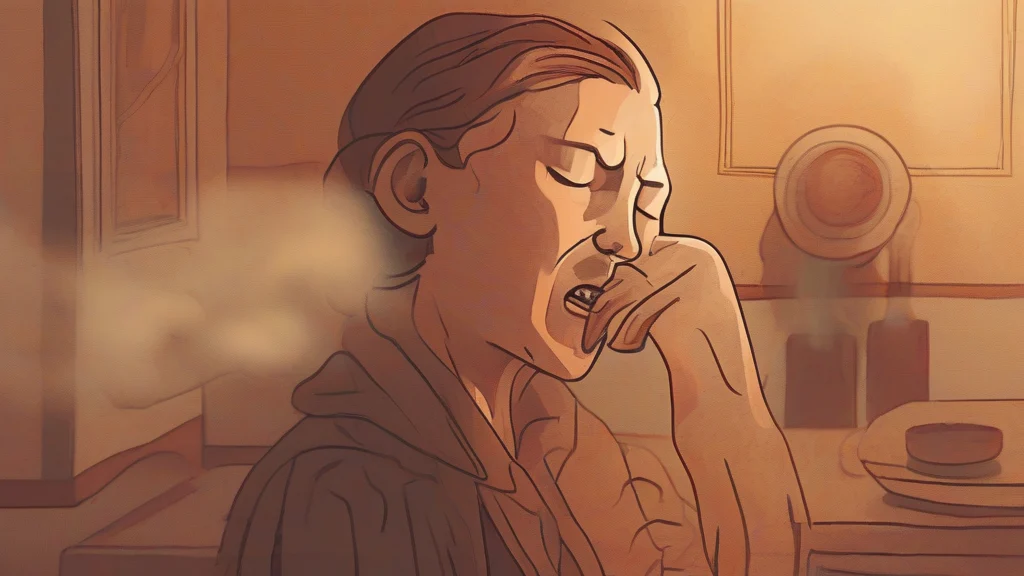
What does coughed mean?
"Coughed" is the past tense of "cough," a verb describing the sudden, noisy expulsion of air from the lungs that clears the throat and airways of irritation, mucus, or foreign particles. It is among the most common bodily actions described in English, appearing in medical contexts, everyday conversation, and literature alike. Beyond its literal sense, the verb carries figurative weight: in the informal phrase "coughed up," it means to reluctantly surrender money or information, as in "he finally coughed up the answer." The manner of coughing can also convey meaning — someone may have "coughed nervously" before a difficult admission, or "coughed violently" through an illness, making the word useful for both physical description and characterization. Etymologically, "cough" traces back to Old English "cohhian," and is widely believed to be imitative, coined from the very sound it describes. Its close relatives appear in other Germanic languages, such as Dutch "kuchen." Simple, ancient, and vivid, "coughed" remains an essential word for describing one of the body's most familiar reflexes.
To have expelled air suddenly and noisily from the lungs in order to clear the throat or airways.
"The smoke was so thick that she coughed for several minutes."
Also used figuratively in "coughed up," meaning to reluctantly yield money or information.
(In "coughed up") To have reluctantly produced or surrendered something owed or demanded.
"He eventually coughed up the rent he had been withholding for weeks."
Informal register; often implies annoyance at being made to pay or reveal something.
The word "cough" is thought to be imitative in origin — Old English speakers essentially named the noise itself, making it one of the language's built-in sound effects.
Reviewed by Deb Chak, Editor. AI-assisted content curated by RJS Tech Solutions LLP.
Etymology of coughed
"Cough" derives from the Old English verb "cohhian," meaning to cough, which is generally believed to be of imitative origin — a word formed by mimicking the sound itself. It belongs to the Germanic family of languages, with a cognate in Dutch "kuchen." The word has remained remarkably stable in form and meaning across nearly a millennium of English, and "coughed" is simply its regular past tense and past participle.
Related word forms
How coughed is actually used
"Coughed" is standard in both formal and informal registers. The phrasal use "coughed up" is informal when applied to money or information, carrying a connotation of reluctance. A dry, persistent cough in speech can also signal hesitation or nervousness before speaking.
Easily confused with coughed
"Coff" is an obsolete Scots spelling/pronunciation variant of cough, not a distinct modern word.