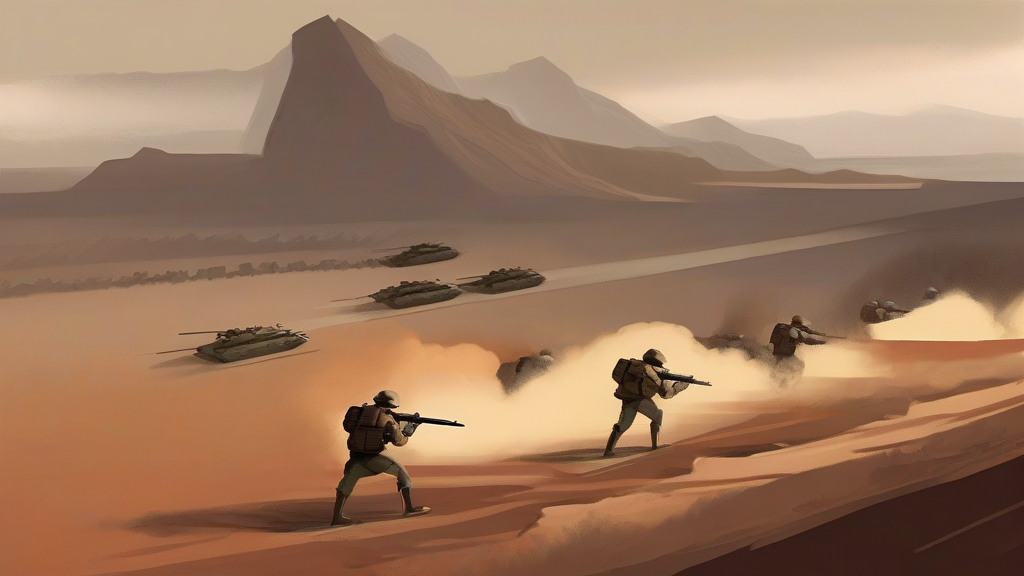
What does countermarch mean?
A countermarch is a maneuver, chiefly military, in which a body of troops turns about and marches back along the route by which it came. Historically it was an essential drill movement, allowing commanders to reposition forces, retreat in good order, or create the impression of withdrawal while preparing another action. Because executing one required every soldier to act in unison without spoken orders, armies developed drum signals — famously 'beating the countermarch' — to communicate the reversal across an entire column. Beyond the battlefield, the word can describe any literal reversal of movement and, less commonly, a figurative about-turn in policy or plans. It functions as both a noun and a verb ('to countermarch'), carries a formal register, and derives from the prefix 'counter-' joined to 'march', reflecting its core sense of moving against one's previous direction.
A military maneuver in which troops march back in the reverse direction to their previous line of advance; by extension, any reversal of movement or course of action.
"The battalion's countermarch took them back over the ridge they had crossed that morning."
Most at home in historical or military writing; figurative use is infrequent.
To execute a countermarch; to cause troops to march back in the direction they came from.
"They countermarched at first light, retracing their steps to the river crossing."
Rarely used; the singular normally suffices even when referring to repeated maneuvers.
"The campaign was marked by a series of exhausting countermarches."
In the days before radios, a drummer's special signal — 'beating the countermarch' — was how an entire army knew to turn around mid-column and head back the way it came.
Reviewed by Deb Chak, Editor. AI-assisted content curated by RJS Tech Solutions LLP.
Etymology of countermarch
Countermarch arose in English in the late sixteenth century, formed from the prefix 'counter-' (from Latin 'contra', meaning against or opposite) combined with 'march'. The formation parallels French military terminology of the period, and the word belongs to the large family of 'counter-' compounds — such as countermand, counterpart, and counterattack — that entered English largely through French during the early modern era. Its earliest uses are firmly rooted in the drill manuals and battle accounts of Renaissance European armies.
Related word forms
How countermarch is actually used
Primarily a formal or technical term drawn from military vocabulary; figurative use for reversals of policy is comparatively rare. The plural noun form is uncommon.
Easily confused with countermarch
Countermand means to revoke or cancel an order, while countermarch is a physical maneuver of marching back the way one came.