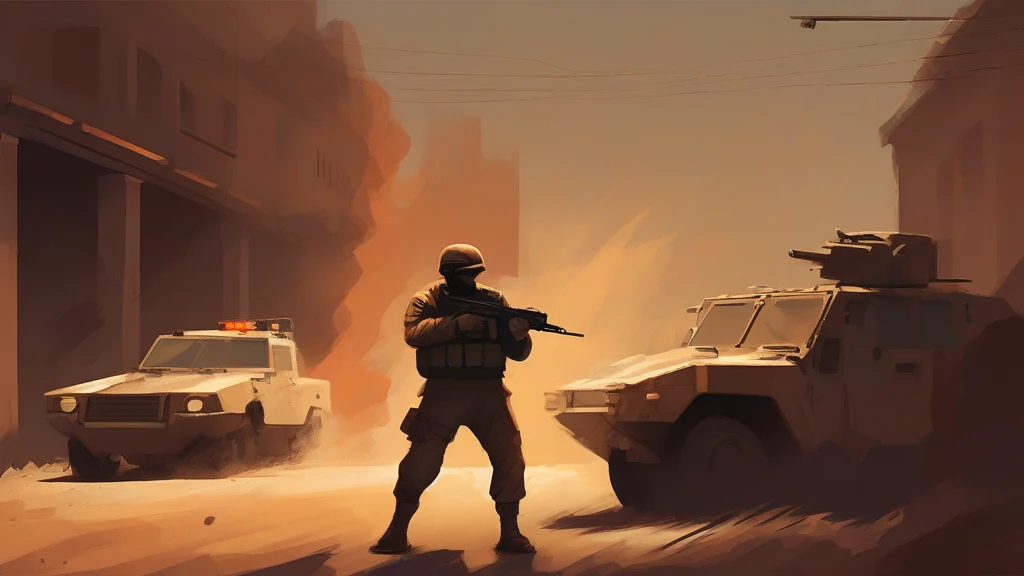
What does counterstrike mean?
A counterstrike is a retaliatory blow delivered in response to an attack, most commonly in military or strategic contexts. The noun can describe anything from a battlefield maneuver to a nation's planned nuclear response, while the verb form means to deliver such a blow. The word combines 'counter-', indicating opposition or response, with 'strike', making its meaning transparent: a strike answered by another strike. Counterstrike carries a formal, martial connotation, so writers typically reserve it for warfare, international relations, or competitive sport rather than casual disputes. Its close relative counterattack differs subtly, tending to describe larger operations, whereas a counterstrike suggests a direct, immediate answer to an enemy's action. The phrase 'nuclear counterstrike' has given the word particular weight in discussions of deterrence, where the credible threat of striking back is central to strategic doctrine.
A retaliatory blow or attack made in response to an enemy's strike, especially in warfare or armed conflict.
"The general ordered a counterstrike before dawn, catching the invaders off guard."
Often used with verbs like launch, mount, plan, or deliver; in nuclear strategy, 'nuclear counterstrike' refers specifically to a second-strike response.
To deliver a retaliatory blow or attack in response to an attack.
"The battalion counterstruck within hours of the ambush."
Standard English plural; used when referring to multiple retaliatory strikes, whether across different conflicts or successive blows within one campaign.
"The rebels carried out several counterstrikes along the northern front."
Though it sounds like a video game title, counterstrike has been standard military vocabulary for over a century — and 'nuclear counterstrike' remains one of the most sobering phrases in geopolitics.
Reviewed by Deb Chak, Editor. AI-assisted content curated by RJS Tech Solutions LLP.
Etymology of counterstrike
Counterstrike is formed from the prefix 'counter-', borrowed through Old French from Latin 'contra' meaning 'against', combined with the native English verb 'strike'. The compound follows the same productive pattern as earlier formations such as counterstroke and counterattack, which date to the early modern period. Its cognates include counterpart, countermeasure, and encounter, all descendants of the Latin root 'contra'. While the exact date of first attestation is uncertain, the word became established in English military vocabulary by the late nineteenth century and gained prominence during the twentieth, particularly in nuclear strategy.
How counterstrike is actually used
The word is neutral-to-formal in register and appears most frequently in military, geopolitical, and sports contexts. In everyday figurative use, synonyms like retaliation or comeback are more common; counterstrike carries a distinctly martial tone.
Easily confused with counterstrike
The two are near-synonyms, but a counterstrike typically emphasizes a single retaliatory blow delivered in direct response to an attack, while counterattack often denotes a broader military operation that may be pre-planned.
Counterstroke is the older, more literary term for a retaliatory blow, whereas counterstrike is the more modern term, now strongly associated with military and strategic contexts.