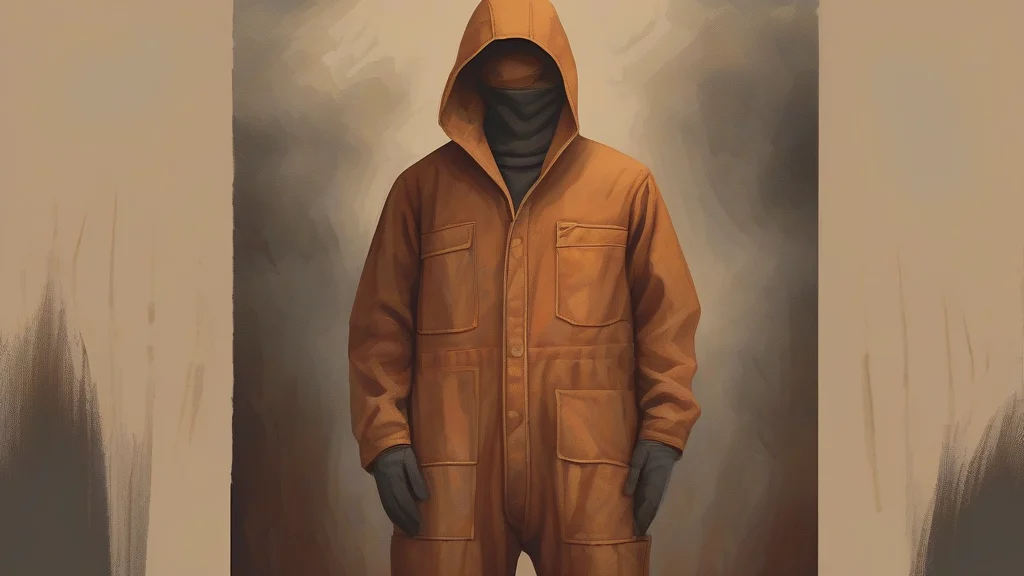
What does coverall mean?
A coverall is a loose-fitting, one-piece protective garment that covers the whole body — torso, arms, and legs — and is worn over ordinary clothing to keep dirt, grease, paint, or chemicals off it. Mechanics, painters, welders, factory workers, and laboratory staff are its classic wearers, which has made it a familiar symbol of manual labor in film and photography. The word is used most naturally in the plural form, 'coveralls', though the singular appears occasionally. In American English, 'coverall' can also function as an adjective meaning comprehensive or all-inclusive, as in a 'coverall' insurance policy or a 'coverall' term that lumps many things together; this sense is largely confined to formal business and legal contexts. British speakers are more likely to call the same garment 'overalls' or a 'boilersuit', making regional awareness useful. The word derives simply from the verb 'cover' plus 'all', transparently describing what the garment does.
A one-piece protective garment, usually worn over regular clothing, that covers the body and legs to protect against dirt, grease, or damage during work.
"She kept a spare pair of coveralls hanging in the barn for messy chores."
Almost always encountered in the plural form 'coveralls'; the singular 'a coverall' is valid but less frequent.
Designed or serving to include or cover a wide range of things; all-encompassing.
"The contract included a coverall clause assigning liability for any breach."
Chiefly North American; found mostly in legal, insurance, and commercial writing.
The plural 'coveralls' is the standard and overwhelmingly common form when referring to the garment, even for a single item; it is treated like a plurale tantum, similar to 'trousers' or 'scissors'.
"He bought two new pairs of coveralls for the workshop."
One word, two jobs: 'coverall' is both the mechanic's armor — the one-piece suit that swallows grease and grime — and the insurance industry's shorthand for policies that blanket everything at once.
Reviewed by Deb Chak, Editor. AI-assisted content curated by RJS Tech Solutions LLP.
Etymology of coverall
Coverall is a straightforward English compound of the verb 'cover' (from Old French covrir, ultimately from Latin cooperire, 'to cover completely') and 'all'. The compound arose as a descriptive name for the one-piece work garment, whose defining feature is that it covers the entire body, with the noun form emerging in American usage in the late 19th or early 20th century alongside related terms like 'overall' and 'boilersuit'. Its Latin root 'cooperire' also underlies words such as 'cover', 'coverage', 'uncover', and 'discovery'.
Related word forms
How coverall is actually used
The noun is almost always used in the plural ('coveralls') when referring to the garment; the singular 'a coverall' occurs but is less common. The adjectival sense ('coverall policy', 'coverall term') appears chiefly in American legal, insurance, and business writing. In Britain, the equivalent garment is more commonly called 'overalls' or a 'boilersuit'. Register is neutral to informal-technical.
Easily confused with coverall
Overalls are a bib-and-braces garment worn over the upper body with shoulder straps, whereas coveralls are a single one-piece suit covering the whole body.