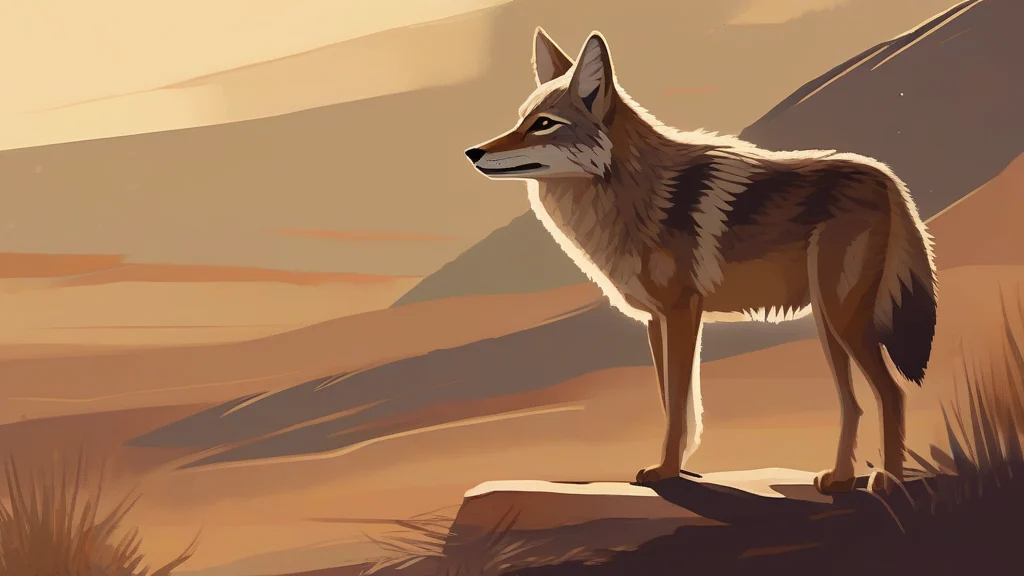
What does coyote mean?
The coyote is a wild canine native to North America, scientifically named Canis latrans. Smaller than the wolf and larger than a fox, it has grayish-brown fur, a narrow muzzle, erect ears, and a bushy tail held low when running. Renowned for its remarkable adaptability, the coyote inhabits nearly every environment on the continent, from open desert and prairie to dense forest — and increasingly, city parks and suburban neighborhoods. Its most famous trait is its voice: a chorus of high-pitched yips, barks, and wavering howls used for communication within family groups. Beyond biology, the word carries rich cultural weight; many Native American traditions feature Coyote as a clever, mischievous trickster whose schemes often backfire. In the southwestern United States, 'coyote' also informally denotes a person who guides migrants across the border, usually for payment. Few animals so thoroughly embody both wild resilience and enduring myth.
A wild canine (Canis latrans) native to North America, smaller than a wolf, with grayish-brown fur, pointed ears, and a characteristic yipping howl.
"The rancher spotted a coyote prowling near the chicken coop at twilight."
Plural is 'coyotes'; pronunciation varies by region, with some speakers dropping the final vowel.
Informal: a person who smuggles immigrants across the United States–Mexico border, typically for a fee.
"Migrants sometimes rely on a coyote to navigate the dangerous desert crossing."
Common in Southwestern US usage and journalism about immigration.
In the mythology of many Native American peoples, Coyote is a trickster spirit or culture hero, often depicted as cunning, foolish, or transformative.
"In the old stories, Coyote steals fire from the gods and brings it to humankind."
Usually capitalized when referring to the mythological figure.
Standard plural formed by adding -s; no irregularities.
"Several coyotes gathered at the edge of the field, calling to one another in the dark."
The coyote's scientific name, Canis latrans, means 'barking dog' in Latin — but it can run up to 40 mph and has expanded its range despite human efforts to eliminate it.
Reviewed by Deb Chak, Editor. AI-assisted content curated by RJS Tech Solutions LLP.
Etymology of coyote
The word 'coyote' entered English from Mexican Spanish, which borrowed it from Nahuatl, the language of the Aztecs, where 'cóyotl' referred to the same animal. It was first recorded in English in the early nineteenth century, as Anglo-American settlement pushed into the Southwest. Because it derives from an indigenous Mesoamerican language rather than Latin or Greek, it lacks true European cognates, though Spanish retains the parallel form 'coyote'.
Related word forms
How coyote is actually used
Pronunciation varies regionally: /kaɪˈoʊti/ is standard American, while some Western US speakers use /ˈkaɪ.oʊt/ without the final vowel. The figurative sense referring to migrant smugglers is common in Southwestern US English and news media. In Native American folklore contexts, 'Coyote' is often capitalized as a character name.
Easily confused with coyote
A coyote is notably smaller than a wolf, with a narrower snout and larger ears relative to head size.