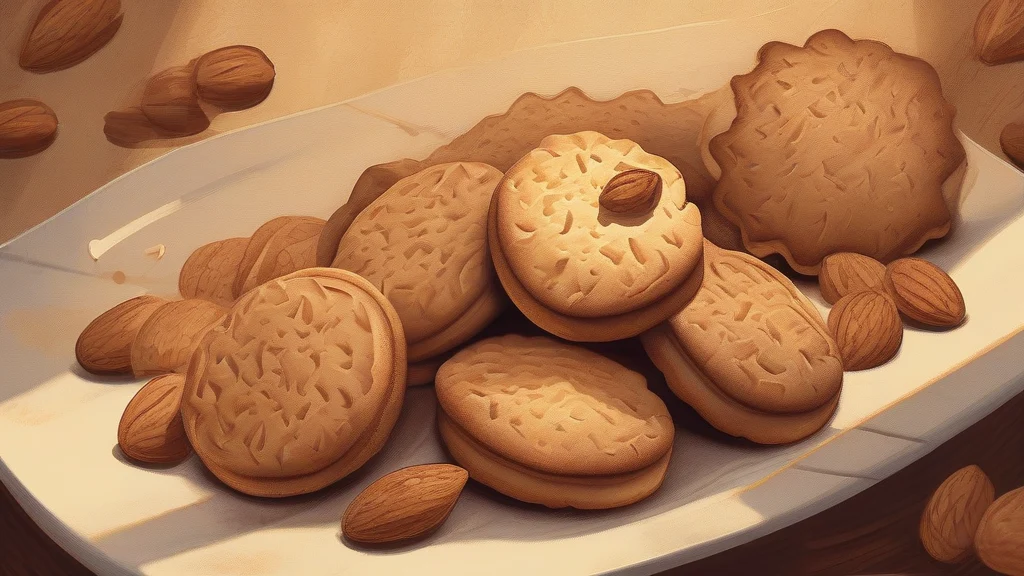
What does cracknel mean?
A cracknel is a hard, crisp, brittle biscuit or small cake, typically sweetened and sometimes enriched with almonds or other nuts. The word belongs chiefly to British English and to an earlier era of home baking, when such twice-baked or thoroughly dried biscuits were prized for keeping well and for their satisfying snap. By extension, cracknel has also been used for the crisp, crackled skin of roast pork — the same quality of brittle crispness applied to meat rather than flour. Today the word is rare, encountered mostly in historical cookbooks, regional dialect, and discussions of traditional baking, where 'biscuit', 'cracker', or 'crispbread' would be the everyday equivalents. Its charm lies in its evocativeness: the word itself seems to crackle, echoing the sound of the thing it names, which makes it a favourite among writers who relish old food vocabulary.
A hard, crisp, brittle biscuit or cake, often sweetened and sometimes made with nuts.
"Grandmother's recipe box still held a card for lemon cracknels dusted with sugar."
Chiefly British and somewhat dated; in most modern contexts 'biscuit' or 'cracker' is used instead.
Crisp, crackling skin on roast pork.
"He carved the pork carefully so everyone got a share of the cracknel."
Now usually expressed as 'crackling' in contemporary British English.
Standard plural; countable like most nouns for kinds of biscuit.
"The tin was filled with almond cracknels for the holidays."
Before biscuits had brand names, a cracknel was the crunchiest thing in the pantry — so hard it gave its name to the crackle of roast-pork skin itself.
Reviewed by Deb Chak, Editor. AI-assisted content curated by RJS Tech Solutions LLP.
Etymology of cracknel
Cracknel entered English in the late Middle Ages, borrowed from Old French 'craquelin', a diminutive form built ultimately on the Germanic root behind 'crack'. The French term denoted a hard, crunchy wafer or biscuit, and English adopted both the confection and its suggestive sound symbolism. The extended sense of crisp roast-pork skin arose from the same association with brittleness and crackling noise. Cognates include modern French 'craquelin' and related words built on the same Germanic root that also yields English 'crack' and 'crackle'.
How cracknel is actually used
Cracknel is now largely archaic or regional, surviving mainly in British dialect and historical cookery writing. In American English it is essentially obsolete except in older recipes. When referring to roast pork, it overlaps with the more common word 'crackling'.
Easily confused with cracknel
A kernel is the edible seed or core of a nut or grain, whereas a cracknel is a hard, brittle biscuit or piece of crackling.