What does crane mean?
Crane is a versatile English word with two principal meanings: it refers both to a large, elegant wading bird and to a powerful lifting machine. As a bird, the crane is admired for its height, grace, and spectacular courtship dances, and it appears widely in folklore and symbolism across many cultures. As a machine, a crane is essential in construction and shipping, using a projecting arm, cables, and pulleys to hoist heavy loads. The word also functions as a verb meaning to stretch one's neck in order to see something more clearly — a usage so common that 'to crane one's neck' has become a fixed phrase. The two main senses are linked historically: early lifting machines were named after the bird because their long arm resembled the crane's extended neck and beak. This makes 'crane' a rare word in which natural history and engineering share a single term.
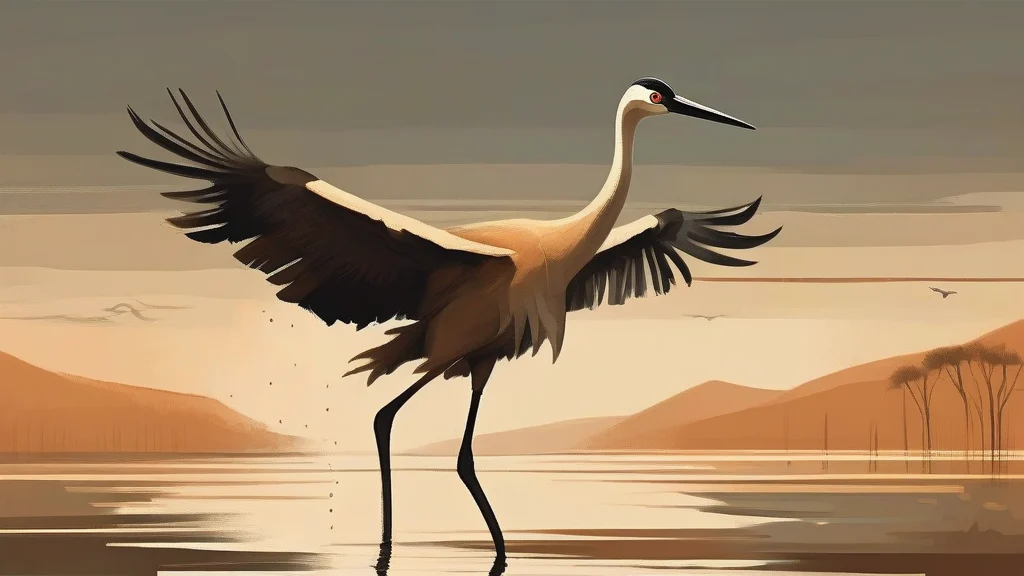
Any of various large, long-legged, long-necked birds of the family Gruidae, noted for their graceful flight and elaborate courtship dances.
"A pair of cranes waded through the shallow marshland at dawn."
Distinguished from herons by their extended necks during flight and their more social behavior.
A large machine equipped with a projecting arm, cables, and pulleys, used for lifting and moving heavy objects, especially in construction and shipping.
"The harbour crane swung containers from the ship onto the dock."
To stretch out or strain one's neck (or another part of the body) in order to see something better.
"He craned forward to read the sign through the fogged window."
Standard plural for both the bird and the machine senses.
"Thousands of cranes gathered at the wildlife reserve during migration season."
Cranes have danced on Earth for millions of years — fossil evidence suggests they existed before most modern songbirds, making their courtship dance one of nature's oldest choreographies.
Reviewed by Deb Chak, Editor. AI-assisted content curated by RJS Tech Solutions LLP.
Etymology of crane
The word 'crane' comes from Old English 'cran', which derives from Proto-Germanic '*kranaz', related to the bird's call or its general form. It shares ancestry with German 'Kranich' and Dutch 'kraan'. The mechanical sense arose in Middle English, when lifting devices resembling the bird's long neck and beak were given the same name. Related Greek roots appear in words like 'geranos' (the ancient Greek term for crane), which survives indirectly in botanical names such as 'cranesbill' (a type of geranium).
Related word forms
How crane is actually used
'Crane' as a verb is always about stretching the neck or body to look at something — often used reflexively ('She craned to see'). The bird and machine senses are entirely distinct but share the name because early cranes (machines) were thought to resemble the bird's long neck and beak.
Easily confused with crane
Herons are similar long-legged wading birds but belong to a different family; herons fly with their necks folded back, whereas cranes fly with their necks extended.
'Crain' is not a standard English word — it is typically a misspelling of 'crane'.