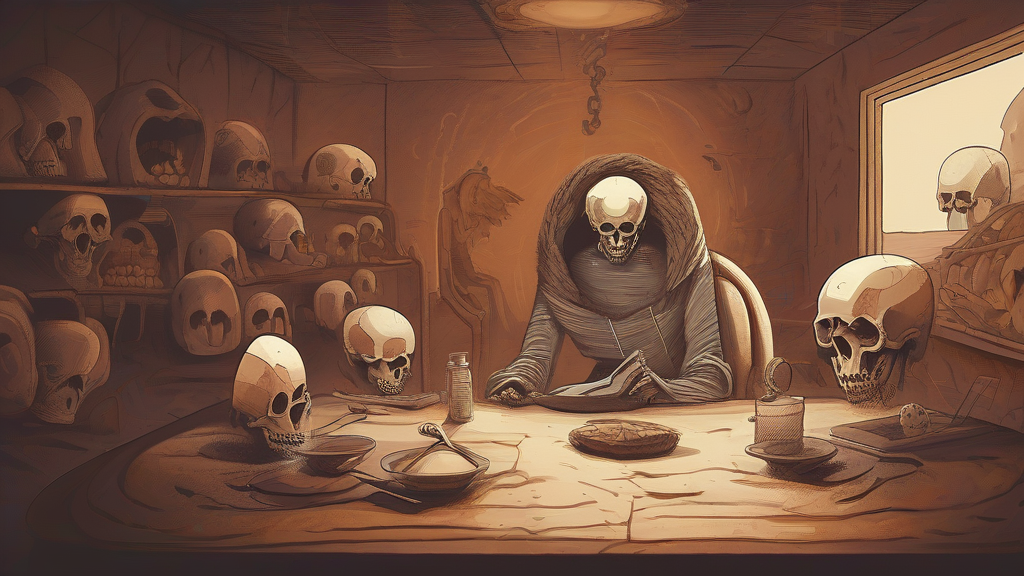
What does crania mean?
"Crania" is the plural of "cranium", the formal anatomical term for the skull — specifically the rounded bony vault that houses and protects the brain, distinct from the bones of the face. While everyday English gets by perfectly well with the word "skulls", "crania" is the form you will encounter in scientific writing on human evolution, forensics, medicine, and comparative anatomy, where precision about skeletal structures matters. A researcher might measure fossil crania to estimate brain volume in extinct hominins, or a forensic anthropologist might examine crania to determine the age, sex, and ancestry of remains. The word carries a distinctly clinical, scholarly tone: it appears almost exclusively in academic papers, textbooks, and museum contexts rather than casual conversation. Because it is already a plural form, it takes no further plural ending, and it pairs naturally with adjectives such as "fossilised", "human", or "fragmentary". For readers interested in science and history, recognising "crania" opens up a rich vein of literature on how our species' braincase has changed over time.
noun"Crania" is the standard English plural of "cranium", meaning the skullbones enclosing the brain — especially the upper part of the skull as distinct from the facial bones.
- The plural of cranium: the bony structure enclosing the brain, especially the upper part of the skull as distinct from the face.
"The museum's collection of primate crania allowed researchers to trace changes in brain size over millions of years."
"The archaeologists catalogued the excavated crania before shipping them to the laboratory for analysis."
"Comparative anatomists measured the crania of several hominin species to chart the expansion of the braincase."
"Crania" is itself a plural noun and takes no additional plural ending. Its singular is "cranium".
"Each of the recovered crania was photographed and scanned for measurement."
A single museum drawer can hold dozens of crania — and each one is someone's entire evolutionary history in bone.
Reviewed by Deb Chak, Editor. AI-assisted content curated by RJS Tech Solutions LLP.
Etymology of crania
"Cranium" entered English in the early 15th century, borrowed from Medieval Latin "cranium", which itself derives from the Greek "kranion", meaning the upper part of the head or skull. The Greek word is traditionally linked to "kara", meaning head, a term that traces back to the Proto-Indo-European root for head and horn — the same ancient root that underlies English words like "horn" and "unicorn". The plural "crania" preserves the Latin-style neuter plural ending, which is why it does not simply add an "-s".
Related word forms
How crania is actually used
"Crania" belongs chiefly to formal, technical registers — anatomy, physical anthropology, palaeontology, and forensic science. In everyday speech, most people simply say "skulls" rather than using either "cranium" or "crania". Note that "crania" is already plural, so it should never take an additional plural ending.
Easily confused with crania
"Cranium" is the singular form referring to one skull, while "crania" is its plural referring to two or more.
"Cranial" is an adjective describing something relating to the skull (as in "cranial nerves"), whereas "crania" is a plural noun naming the skulls themselves.