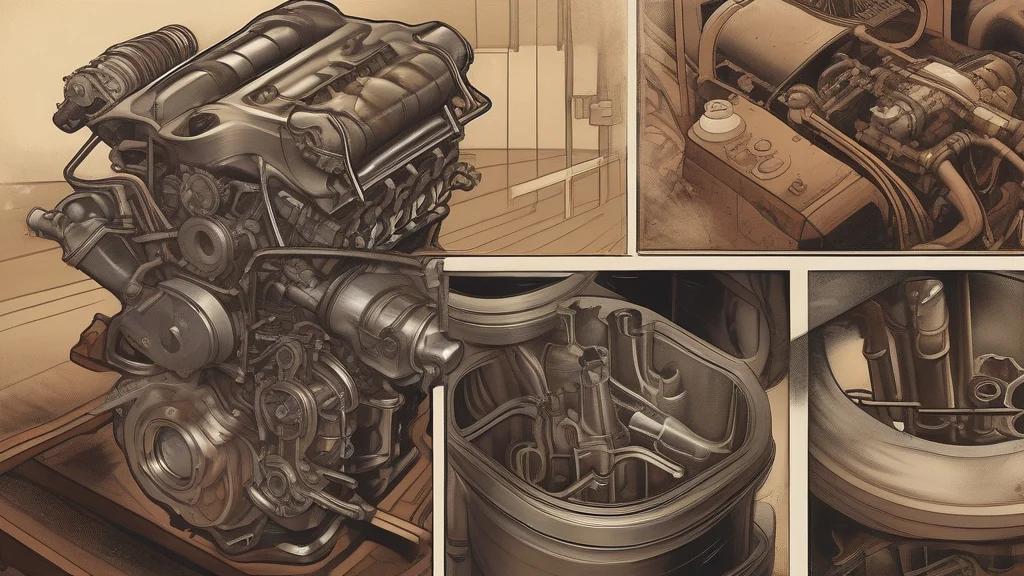
What does crankcase mean?
A crankcase is the rigid housing, typically cast in aluminium or iron, that encloses the crankshaft of an engine — whether in a car, motorcycle, lawnmower, or stationary machine. Its job is partly structural: it supports the main bearings in which the crankshaft spins, seals the interior against dirt and debris, and contains the oil mist generated during operation. In most conventional engines the crankcase also acts as the oil reservoir, so the drain plug through which old oil is removed sits at its lowest point. The word is a straightforward compound of 'crank' and 'case', reflecting exactly what it is: the casing around the crank mechanism. Because damage to the crankcase — a crack, a stripped thread, contamination from metal fragments after an internal failure — can be catastrophic for an engine, the term appears frequently in mechanical repair manuals, insurance assessments of accident-damaged vehicles, and discussions of engine rebuilding. It belongs firmly to technical register rather than everyday conversation, but it is essential vocabulary for anyone working on or writing about engines.
nounThe housing of an internal-combustion or other reciprocating engine that encloses the crankshaft and, in most engines, doubles as the reservoir for lubricating oil.
- The metal housing of an engine that encloses the crankshaft, often serving as the oil reservoir.
"A hairline crack in the crankcase allowed oil to seep onto the garage floor overnight."
"Mechanics drained the old oil directly from the plug at the bottom of the crankcase."
"After the piston failed, fragments of metal were found scattered inside the crankcase."
The plural is regular and appears mostly in industrial, manufacturing, or repair-shop contexts when referring to multiple engines.
"The foundry casts several hundred aluminium crankcases each week."
In most car engines, the crankcase does double duty — it holds the spinning crankshaft and serves as the sump where all the engine's oil pools.
Reviewed by Deb Chak, Editor. AI-assisted content curated by RJS Tech Solutions LLP.
Etymology of crankcase
Crankcase is a compound of 'crank', the word for the bent shaft-and-arm mechanism that converts rotary motion into reciprocating motion (ultimately from Old English 'cranc', related to words meaning bent or twisted), and 'case', meaning an enclosing container, which derives from Latin 'capsa' via Old French 'chasse' or 'caisse'. The term arose naturally in the nineteenth century as engine technology matured and engineers needed precise names for individual engine components. It shares its 'case' element with words such as 'capsule' and 'cassette', all tracing back to the same Latin root.
Related word forms
How crankcase is actually used
A technical term used mainly in automotive and mechanical engineering contexts; in everyday speech, non-specialists often refer loosely to 'the engine' rather than the crankcase specifically. In many engines, especially older or simpler designs, the crankcase also functions as the oil sump, though some designs keep these separate.
Easily confused with crankcase
The crankshaft is the rotating shaft inside the engine, while the crankcase is the metal casing that houses it.