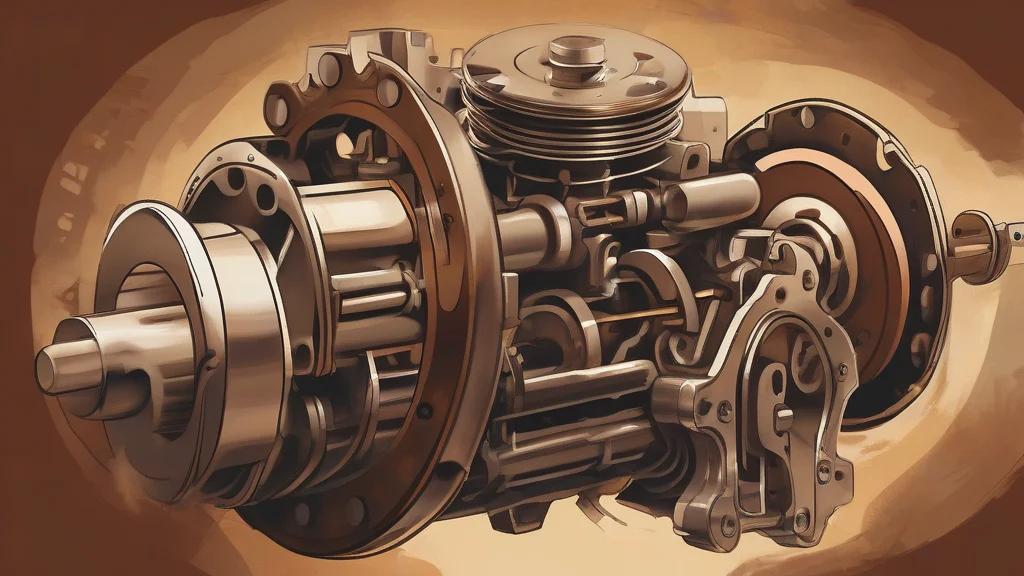
What does crankshaft mean?
A crankshaft is a rotating shaft fitted with offset cranks, used chiefly in engines to convert the reciprocating, or back-and-forth, motion of pistons into the rotary motion that ultimately turns a vehicle's wheels. Found in virtually every internal combustion engine as well as many pumps and compressors, it is one of the most important components in mechanical engineering. The word belongs primarily to technical and automotive contexts: mechanics speak of bent crankshafts, worn crankshaft bearings, or a crankshaft pulley, and the term carries no emotional connotation — it is simply precise engineering vocabulary. Etymologically it combines 'crank', the offset lever at the heart of the mechanism, with 'shaft', the rotating rod itself, reflecting the straightforward descriptive habit of English technical naming. Understanding the word opens the door to grasping how engines work at all.
nounA shaft driven by a crank that converts reciprocating motion into rotary motion, most notably in an engine where it turns the pistons' up-and-down movement into rotation.
- A rotating shaft with offset cranks, found especially in engines and pumps, that converts back-and-forth (reciprocating) motion into circular (rotary) motion, or vice versa.
"The mechanic replaced the worn bearings on the crankshaft to stop the engine from knocking."
"A cracked crankshaft meant the entire engine had to be rebuilt."
"The steam pump's crankshaft converted the pistons' vertical strokes into the rotary motion needed to drive the flywheel."
The plural is regular and appears when discussing multiple engines or machines, though in practice the singular is far more common because each machine typically has one crankshaft.
"The factory machines hundreds of crankshafts every week for automotive manufacturers."
Every mile your car travels, its crankshaft has spun tens of thousands of times — converting fiery explosions into smooth, continuous rotation since the dawn of the automobile.
Reviewed by Deb Chak, Editor. AI-assisted content curated by RJS Tech Solutions LLP.
Etymology of crankshaft
The word 'crankshaft' is a compound of 'crank', which entered Middle English from Old French 'cranque', likely of Germanic origin, and 'shaft', from Old English 'sceaft'. The compound arose during the development of mechanised machinery, becoming widespread in the nineteenth century as steam engines and later internal combustion engines made the component ubiquitous. It shares its root with related mechanical terms such as 'crankcase', 'crankpin', and 'crankarm', all built around the same core idea of an offset turning arm.
How crankshaft is actually used
A technical term used mainly in mechanical engineering, automotive repair, and discussions of engines and machinery. It is neutral in register but rarely appears outside these contexts.
Easily confused with crankshaft
A camshaft operates the engine's valves via cams, while a crankshaft converts piston motion into rotation; the two are linked but perform different jobs.
A driveshaft transmits torque along a vehicle to the wheels, whereas a crankshaft converts the pistons' linear motion into rotation inside the engine itself.