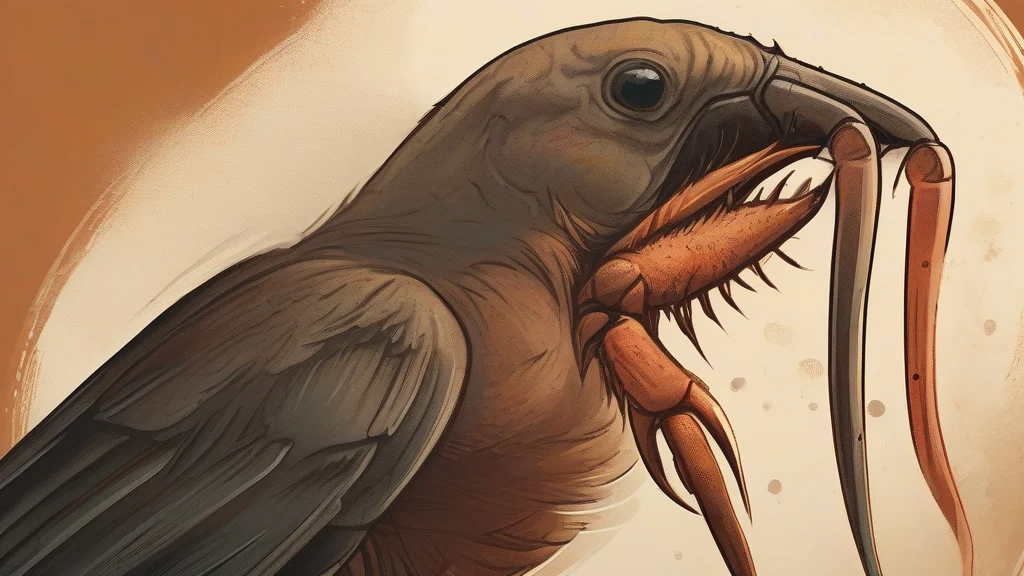
What does craw mean?
A craw is the crop of a bird: the muscular pouch at the base of its throat where food is stored and softened before moving on to the stomach. In everyday English, however, the word survives chiefly through the idiom 'to stick in one's craw,' meaning that something — usually an insult, an injustice, or an unwelcome fact — is difficult to accept and lingers as a source of resentment. The metaphor draws on the physical act of swallowing: just as a bird's food lodges in its craw, so a grievance lodges in the figurative throat of the person who cannot bring themselves to swallow it. Outside this idiom, 'craw' appears mostly in agricultural, hunting, and ornithological writing, and it lends a slightly old-fashioned, earthy flavor to prose. Its enduring presence in speech makes it a small but vivid piece of the language's rural heritage.
The crop of a bird — the pouch in its gullet where food is stored before digestion.
"The falcon's craw was visibly full after feeding."
Literal uses today appear mainly in farming, falconry, and ornithological contexts.
Used figuratively in the idiom 'stick in one's craw,' referring to the throat as the place where an insult or grievance is swallowed and resented.
"His dismissive remark stuck in my craw all evening."
This idiomatic sense is by far the most common usage in contemporary English.
The plural is regular and used when referring to the crops of multiple birds.
"The vet explained how the chickens' craws help them digest coarse grain."
When something 'sticks in your craw,' you're borrowing a bird's anatomy to explain your grudge — and the phrase is centuries older than most of the words you use every day.
Reviewed by Deb Chak, Editor. AI-assisted content curated by RJS Tech Solutions LLP.
Etymology of craw
The word 'craw' descends from Middle English 'crawe,' itself from Old English 'cræga,' meaning the crop or stomach of a bird. It belongs to a family of Germanic words for the digestive organs of animals, though precise cognates outside English are not firmly established. The figurative idiom 'stick in one's craw' developed from this literal sense by the seventeenth century, extending the image of food lodged in a bird's crop to grievances lodged in a person's throat.
How craw is actually used
In its literal anatomical sense, 'craw' is now largely confined to ornithology, farming contexts, and older literary prose. Most modern readers encounter it only through the idiom 'stick in one's craw,' which carries a connotation of festering resentment or indignation at something one finds hard to accept or swallow. It is somewhat informal but well established in both British and American English.
Easily confused with craw
'Crawl' is a verb meaning to move slowly on hands and knees (or a swimming stroke), while 'craw' is a noun naming a bird's crop or, figuratively, the throat.