What does creamery mean?
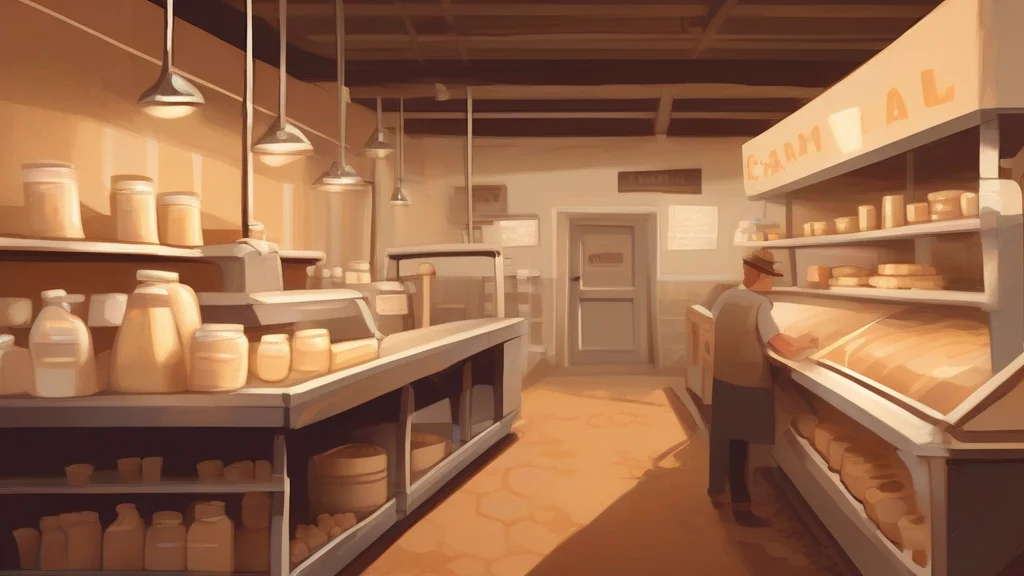
A creamery is a facility devoted to making dairy products—most classically butter and cheese—from milk and cream. The word derives from 'cream', the rich fatty layer separated from milk, combined with the suffix '-ery', denoting a place of manufacture. Historically, creameries ranged from farmhouse rooms where butter was churned by hand to large cooperative enterprises, particularly prominent in rural Ireland and the American Midwest, where farmers pooled their milk for shared processing. Today the term enjoys renewed popularity among artisanal cheesemakers and small-batch ice-cream producers, giving it a warm, craft-oriented connotation. It can also refer to a retail shop selling such goods. Whether describing a historic co-op, a modern artisan workshop, or a scoop shop on a summer street corner, 'creamery' evokes freshness, tradition, and the pastoral origins of good food, making it a favorite word for dairies marketing quality and authenticity.
nounA place or establishment where milk and cream are processed into butter, cheese, and other dairy products; also, a shop or business that sells such dairy goods.
- A factory or establishment where butter, cheese, and other dairy products are made.
- A shop selling dairy products, especially one associated with an ice-cream maker.
"The small-town creamery has been churning butter the traditional way since 1902."
"Visitors can watch the cheesemaking process at the village creamery every morning."
"After dinner we stopped at a little creamery for hand-scooped ice cream cones."
Standard plural, following regular English pluralization.
"Several family-owned creameries operate across the county."
Ireland's Kerrygold empire began as a single cooperative creamery — and the word 'creamery' once described the room in a farmhouse where butter was churned by hand.
Reviewed by Deb Chak, Editor. AI-assisted content curated by RJS Tech Solutions LLP.
Etymology of creamery
The word 'creamery' was formed in the nineteenth century by combining 'cream'—itself borrowed from Middle French 'cresme', ultimately from Late Latin 'crisma' meaning oil-based unguent—with the productive English suffix '-ery', which marks a place of activity. It emerged alongside similar industrial formations like 'bakery' and 'brewery' during the era of specialized food processing. Its strongest historical associations are with Irish and American cooperative dairying of the late nineteenth and early twentieth centuries.
How creamery is actually used
In Ireland and parts of Britain, 'creamery' historically referred to cooperative butter-making facilities and remains strongly associated with Irish dairy heritage. In the United States it often denotes artisanal cheese producers or ice-cream shops. The word carries a wholesome, old-fashioned, artisanal connotation.
Easily confused with creamery
'Cream' is the fatty layer skimmed from milk or a food product, while a 'creamery' is the facility that processes milk into dairy products.
A 'dairy' broadly refers to milk production or the milk itself, whereas a 'creamery' specifically manufactures butter, cheese, and similar products.