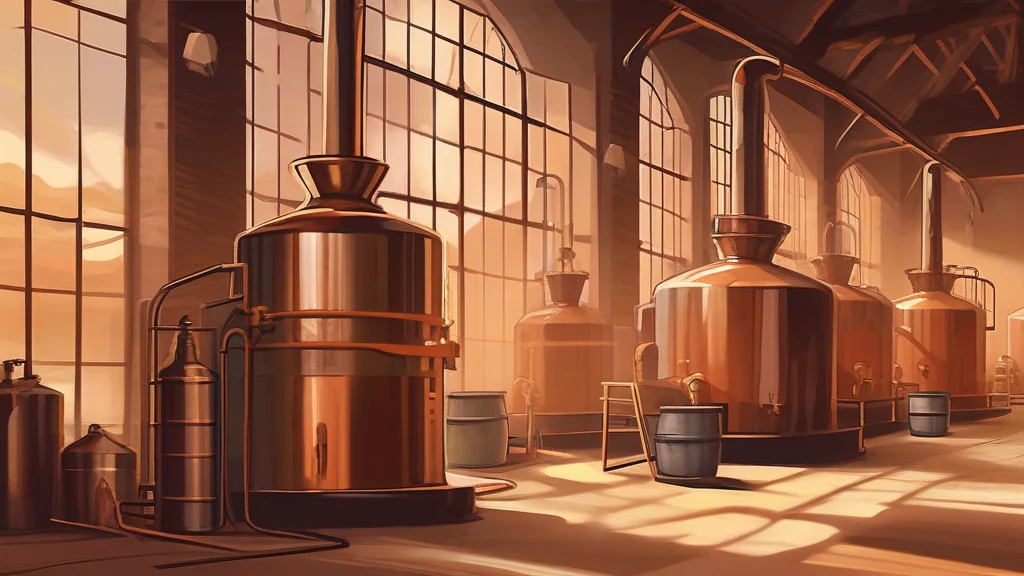
What does distillery mean?
A distillery is a place where liquids are purified or concentrated through distillation — the process of heating a mixture and condensing its vapours. In practice, the word today almost always refers to a facility that produces distilled alcoholic spirits, such as whisky, rum, gin, brandy, or vodka. A distillery may be a vast industrial operation with towering column stills or a small craft workshop producing limited batches by hand; either way, the heart of the process is the still, the equipment in which fermentation wash is boiled and its alcohol-rich vapour collected. Distilleries hold a strong cultural resonance in regions like Scotland, Ireland, Kentucky, and the Caribbean, where they are often tied to local heritage and tourism, and many offer tours and tastings. The related noun "distiller" denotes a person or company engaged in the trade, while "distillation" names the underlying scientific process.
nounA distillery is a place or establishment where a substance, especially alcoholic spirits such as whisky, rum, or gin, is purified or concentrated by distillation. The term also refers to the apparatus used for distilling.
- A place where alcoholic spirits are produced by distillation.
- An apparatus or plant for distilling any liquid substance.
"The single-malt distillery on the Scottish island has been producing whisky by the same traditional methods since 1825."
"Visitors can tour the historic distillery and sample its award-winning single malt."
"A small craft distillery opened last year, producing gin from locally grown botanicals."
Standard plural, formed by changing -y to -ies.
"Kentucky is famous for its bourbon distilleries."
Scotland's Speyside region packs in more than fifty working distilleries — some of them older than the United States.
Reviewed by Deb Chak, Editor. AI-assisted content curated by RJS Tech Solutions LLP.
Etymology of distillery
The word "distillery" derives from "distill", which comes from Latin "destillare", meaning "to trickle down", formed from "de-" (down) plus "stillare" (to drip), itself from "stilla" (a drop). English adopted "distill" via Old French "distiller" around the late Middle Ages, and the noun "distillery" was formed later to denote the place or apparatus of distilling. Cognates and relatives include "distillation", "distillate", and "instill".
How distillery is actually used
"Distillery" is a neutral term used in both everyday and commercial contexts. In modern usage it almost always refers to an alcoholic-spirits producer; the broader sense of a general distilling apparatus is now rare outside technical writing. "Distiller" refers to a person or company that distills.
Easily confused with distillery
A brewery produces beer by fermentation, whereas a distillery produces spirits such as whisky or rum by distillation.