
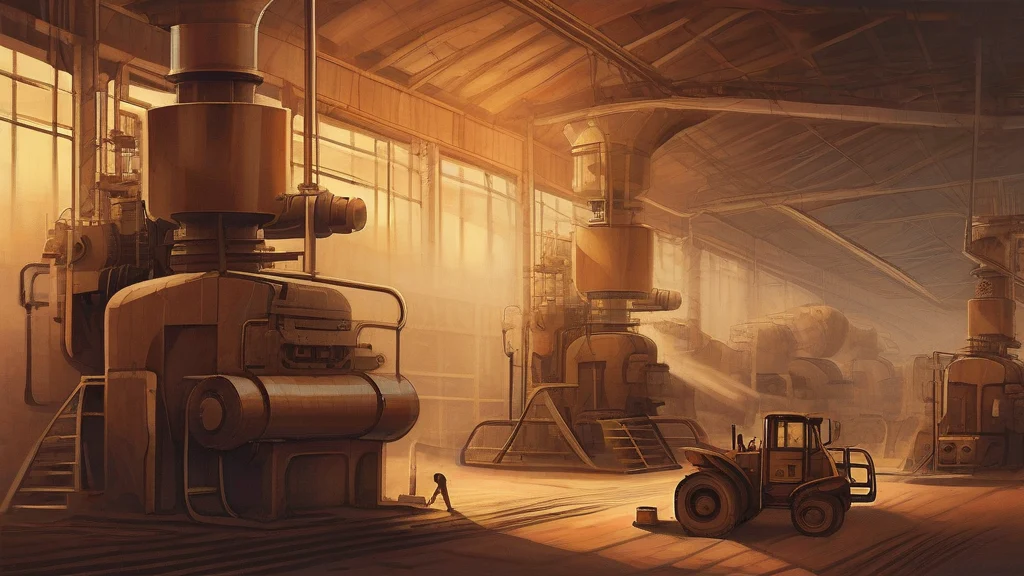
What does machinery mean?
Machinery is the collective term for machines and mechanical equipment used to perform work, operate a process, or support an industry. It is especially common in references to industrial, agricultural, and manufacturing equipment, where it emphasizes the combined system rather than one particular machine. The word also has a broader figurative use: “the machinery of government” refers to the institutions, rules, and procedures through which government operates. In this sense, machinery can imply that a large organization functions through interconnected parts and established processes. The term is generally formal but widely understood in British and American English. Because it usually describes a collection or system, it is commonly uncountable, although “machineries” is used when referring to several distinct sets of machines or systems. Its historical connection to ingenious mechanical devices gives it a lasting association with power, complexity, and coordinated movement.
nounMachinery refers collectively to the machines, devices, and mechanical systems used to perform work or carry out a particular function. By extension, it can mean the organized system or structure through which a political, social, or institutional process operates.
- The collective machines, devices, and mechanical equipment used to perform work or carry out a function.
- The organized system of parts, processes, or institutions that enables a larger organization or activity to function.
- A system of rules, practices, or methods used to achieve an effect, especially in a political or social context.
"The factory invested in new machinery to increase production without hiring additional staff."
"The new machinery has transformed the way the farm operates."
"The reforms changed the machinery of local government."
"The company imported specialized machinery from Europe."
The plural is uncommon and is used mainly for distinct sets of machines or separate systems, rather than for individual pieces of equipment.
"The two factories use different machineries for processing the material."
From a Greek word for a clever lifting device, “machinery” grew to mean not just engines and machines, but the powerful systems that keep societies and organizations moving.
Reviewed by Deb Chak, Editor. AI-assisted content curated by RJS Tech Solutions LLP.
Where does machinery come from?
The word comes through French from Latin machinaria, a term associated with machina, meaning “machine” or “device.” Latin machina itself developed from Greek makhana, referring to a windlass, lifting device, or ingenious contrivance. Over time, the emphasis broadened from individual mechanical devices to machines collectively and, figuratively, to the organized structures by which institutions function.
How machinery is actually used
The word is often used as an uncountable collective noun, especially for industrial or mechanical equipment. In political and institutional contexts, it is usually figurative and can suggest a complex system whose parts operate together.
Easily confused with machinery
A mechanism is a particular machine or the way a process works, whereas machinery usually refers to machines collectively or to an organized system of parts and institutions.