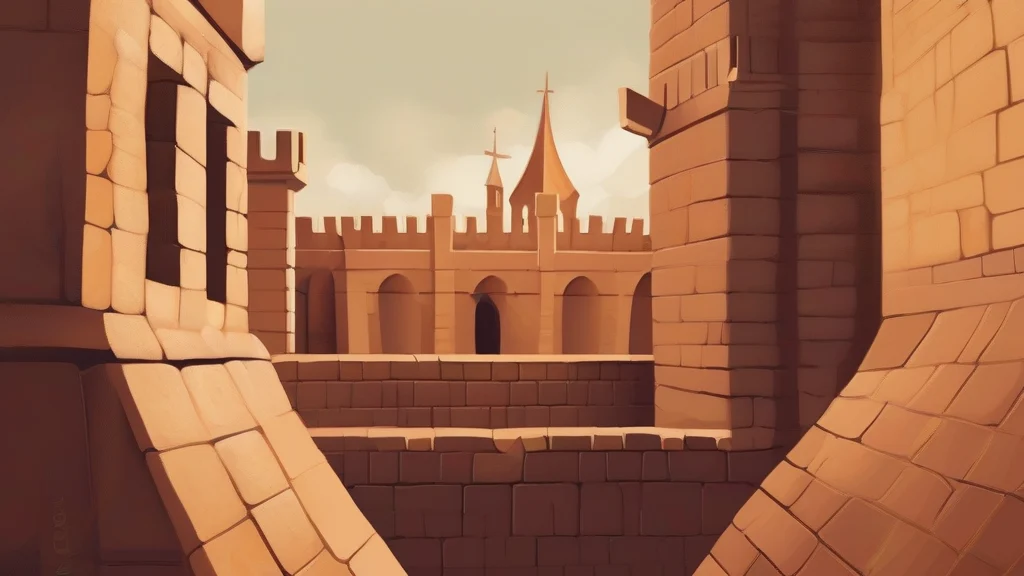
What does crenelated mean?
Crenelated describes a structure—most commonly a wall, tower, or parapet—that is topped with battlements: a series of regular square openings known as crensels, alternating with raised sections called merlons. This distinctive toothed profile is the archetypal feature of medieval military architecture, allowing defenders to shelter between the merlons while firing through the gaps. The term also extends beyond literal fortifications to anything whose edge resembles a battlemented outline, from ornamental building cornices to the jagged rooflines of Gothic Revival architecture. Figurative uses appear in design, biology, and typography whenever a border shows repeated rectangular indentations. The adjective derives from the noun "crenel," ultimately tracing to Old French. Because it immediately conjures images of castles and strongholds, crenelated carries connotations of strength, antiquity, and defensive grandeur. It is a precise, evocative word for writers describing architecture or notched silhouettes, and its variant spellings—British "crenellated" and American "crenelated"—are interchangeable in meaning.
adjectiveHaving a parapet with regular square openings (crenels), as on a castle wall; more broadly, having an edge shaped into repeated notches or battlements.
- (Of walls, towers, or buildings) furnished with battlements or parapets having regular square openings (crenels).
- (By extension) having an edge or outline resembling battlements, marked by regular rectangular notches.
"The crenelated towers of the medieval fortress rose above the valley, their notched silhouettes unmistakable against the sky."
"The soldiers took cover behind the crenelated ramparts as arrows streaked past."
"The Art Deco skyscraper's crenelated crown gave it the air of a modern citadel."
Look up at any fairy-tale castle silhouette and you're seeing the word itself: those tooth-like gaps in the wall are literally called 'crenels', and 'crenelated' means crowned with them.
Reviewed by Deb Chak, Editor. AI-assisted content curated by RJS Tech Solutions LLP.
Etymology of crenelated
Crenelated comes from the French verb "créner," meaning to notch, derived from the noun "crénau" (or "crenel"), which denotes one of the open spaces in a battlement. The ultimate root lies in Late Latin *crena, meaning a notch, itself possibly of Gaulish origin. The English adjective emerged in the early nineteenth century alongside related forms like "crenel" and "crenellation." A doublet spelling with double l, "crenellated," arose in British English and remains the dominant form there, while the single-l spelling prevails in American usage.
Related word forms
How crenelated is actually used
Chiefly used in architectural description, but frequently extended figuratively to describe notched or serrated outlines in design, typography, and even biological structures. The spelling varies: "crenellated" is standard in British usage, while "crenelated" is the typical American form. The word carries connotations of fortification, antiquity, and grandeur, so it often appears in descriptions of castles, Gothic revival buildings, and imposing institutional architecture.
Easily confused with crenelated
"Crenellated" (double l) is simply the standard British spelling of the same word, while "crenelated" is the common American spelling — the meanings are identical.
"Crenulated" describes finely scalloped or wavy edges, such as leaf margins, whereas "crenelated" specifically evokes castle-style battlements.