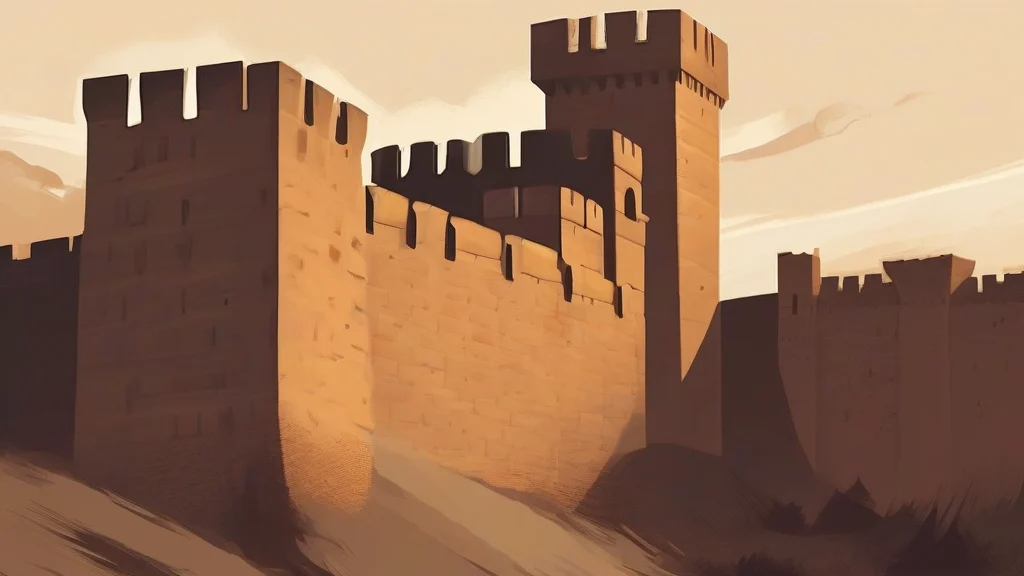
What does crenellate mean?
To crenellate is to equip a wall, tower, or building with battlements: a raised parapet broken by regular gaps. The gaps are called crenels (or embrasures), and the raised blocks between them are merlons; together they allowed defenders to shoot or drop projectiles while remaining shielded. The word is most at home in architectural and military history, where it describes the distinctive jagged skyline of castles, city walls, and fortified churches. Because English law once required a royal licence to crenellate a dwelling, the act itself became a mark of noble status, making the word resonate with power and privilege. By extension, architects and designers use "crenellated" for any structure or object given a notched, castle-like edge, from Art Deco rooftops to ornamental stonework. Though rare in everyday speech, the term is precise, evocative, and indispensable when describing fortified architecture accurately.
verbTo provide a wall or building with battlements — a parapet with regular gaps (crenels) for defensive firing. More broadly, to furnish anything with a notched or crenellated edge resembling battlements.
- To furnish a wall, tower, or building with battlements (a parapet alternating between crenels/gaps and merlons/solid sections) for defense.
- (By extension) To shape an object's edge into a series of regular notches resembling battlements, as in architecture, design, or heraldry.
"The medieval fortress was crenellated to give archers protected vantage points along the curtain wall."
"In the fourteenth century the king granted the baron a licence to crenellate his manor house, turning it into a fortified stronghold."
"The Art Deco skyscraper's rooftop was deliberately crenellated, giving the modern office block the silhouette of a medieval keep."
Every fairy-tale castle silhouette you've ever drawn owes its zigzag top to crenellation — and the gaps have names: they're called crenels, and the solid bits between them are merlons.
Reviewed by Deb Chak, Editor. AI-assisted content curated by RJS Tech Solutions LLP.
Etymology of crenellate
"Crenellate" derives from the Old French "creneler", from "crenel" meaning a notch, ultimately from Vulgar Latin *crenello, a diminutive of Latin "crena" (a notch). It entered English in the late Middle Ages/early modern period alongside the related noun "crenellation". Cognates sharing this root include "crenel" itself and the botanical adjective "crenate", which describes leaf margins with rounded teeth.
Related word forms
How crenellate is actually used
Formal register; chiefly found in architectural history, heritage writing, and descriptions of castles. In England historically significant because building fortifications required royal permission — a formal 'licence to crenellate' — so the word carries connotations of authority and status. The participial form "crenellated" is far more common than the base verb.
Easily confused with crenellate
"Crenate" describes a leaf edge with rounded scalloped teeth in botany, while "crenellate" means to add battlements or a notched, castle-like profile.