What does embattle mean?
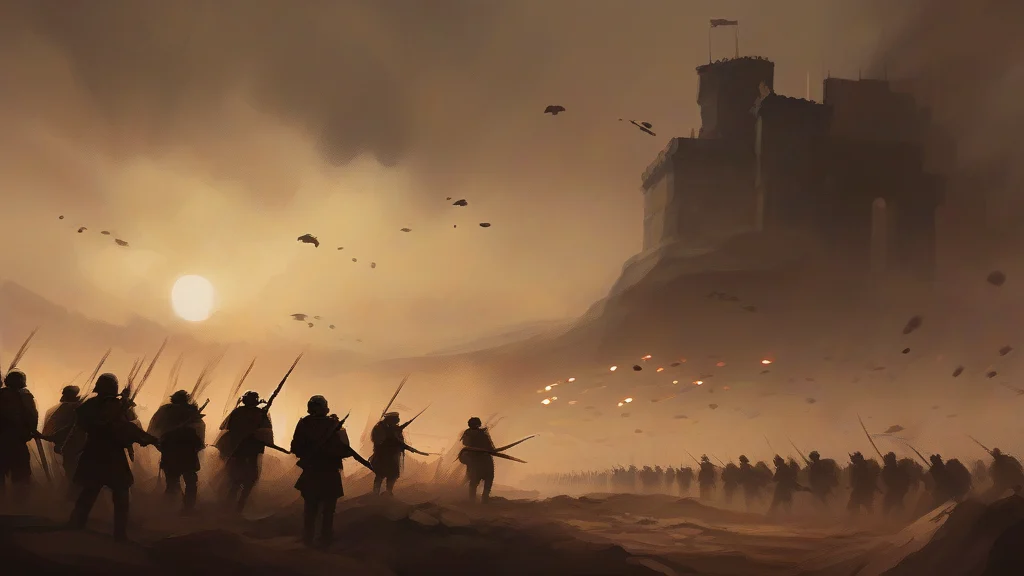
To embattle is to arrange troops in readiness for combat, drawing them up in disciplined formations before an engagement. The word carries strong martial connotations, evoking heraldic banners and massed ranks, and it survives chiefly through its adjective form, 'embattled', which describes anyone or anything under siege by adversity. Beyond its literal military sense, embattle can be used figuratively: a politician may embattle her staff against hostile media, or a community embattle itself against encroaching development. The verb is formal and somewhat archaic in flavor, appearing mostly in historical writing and elevated prose rather than everyday speech. It derives from Old French, sharing deep roots with 'battle' itself, which makes it part of a rich family of English war vocabulary that also includes 'battalion' and 'battlement'. Knowing it enriches both historical reading and forceful contemporary writing about conflict.
To draw up (troops) in order of battle; to prepare for combat.
"Cromwell embattled his cavalry on the left flank."
Almost always transitive; rarely encountered outside historical or deliberately archaic prose.
Figuratively, to ready or strengthen (someone or something) for a struggle or confrontation.
"Union leaders embattled their members for a long strike."
The word behind 'embattled' was born on the battlefield — medieval commanders literally 'embattled' their armies before the fighting began.
Reviewed by Deb Chak, Editor. AI-assisted content curated by RJS Tech Solutions LLP.
Etymology of embattle
Embattle comes from Middle English 'embataillen', borrowed from Old French 'embataillier', formed from 'en-' ('in, into') plus 'bataille' ('battle'). It has been used since medieval times to describe the marshalling of armies. Its root connects it to cognates including 'battle', 'battalion', and 'battlement', all descendants of the Late Latin term underlying 'bataille'.
Related word forms
How embattle is actually used
Formal and literary in register. In modern usage the past participle 'embattled' is far more common than the active verb, usually describing a person, institution, or government under sustained pressure rather than literal military formations.
Easily confused with embattle
Though both begin with the same 'em-/im-' verb-forming prefix meaning 'to put into', embed means to fix something firmly within something else, while embattle means to arrange forces in battle order.