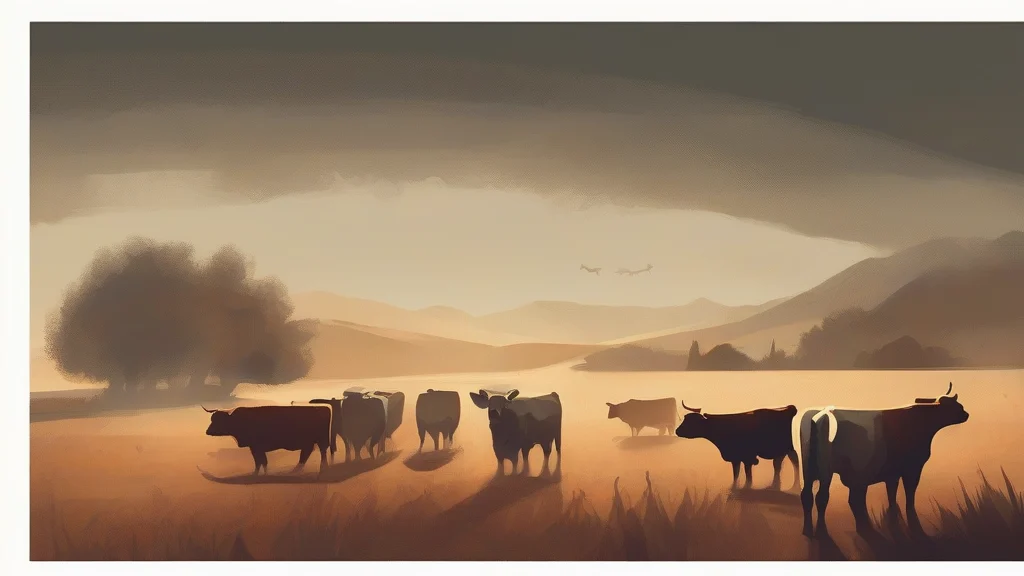
What does cattle mean?
Cattle refers collectively to large domesticated bovines — chiefly cows, bulls, and oxen of the species Bos taurus — that humans raise for meat, milk, leather, draft power, and other purposes. The word functions as a plural noun with no distinct singular form; one speaks of a single cow, bull, or ox rather than 'a cattle.' Cattle appears constantly in agricultural, economic, and historical contexts: one raises cattle on a farm or ranch, drives them along trails, or counts heads of cattle as a measure of wealth. Beyond its literal sense, cattle carries a strong figurative meaning when applied to people, implying they are being treated as an undifferentiated herd — packed together, moved without consent, or denied individual identity. This pejorative connotation gives the word rhetorical force in political and social commentary. Etymologically fascinating, cattle derives from the same Latin root as chattel (personal property) and capital, reflecting a time when movable wealth was measured in livestock.
Domesticated bovine animals, especially cows and bulls, raised as livestock for meat, milk, or labor.
"The drought forced the farmer to sell off half his cattle."
People regarded or treated as a mindless herd, without individual consideration or respect.
"The commuters were crammed into the train like cattle."
Cattle is a plurale tantum — it exists only as a plural and takes plural verbs. To refer to a single animal, use cow, bull, ox, steer, or calf depending on age and sex.
"The cattle are grazing in the lower field."
The word 'cattle' once meant any kind of property you could own — which is why 'chattel' (as in human slavery) and 'capital' come from the exact same root.
Reviewed by Deb Chak, Editor. AI-assisted content curated by RJS Tech Solutions LLP.
Etymology of cattle
Cattle derives from Old North French catel, from medieval Latin capitale, meaning 'property' or 'wealth,' itself from Latin caput, 'head.' In Middle English the word originally meant any kind of movable personal property, not just livestock, before narrowing over time to refer specifically to live animals and then exclusively to bovines by the sixteenth century. The same Latin root gave English chattel, which retains the older legal sense of personal property, and capital, reflecting the idea of wealth or principal. This shared origin makes cattle etymologically linked to words for ownership and value.
How cattle is actually used
Cattle is a plural-only noun in modern usage — there is no singular form ('cow' or 'ox' is used instead). It takes plural verbs ('the cattle are grazing'). The word is uncountable in the sense of the category as a whole.
Easily confused with cattle
Cattle refers to livestock animals, while chattel refers to personal property or movable possessions — both share the same Latin root caput but diverged in meaning.