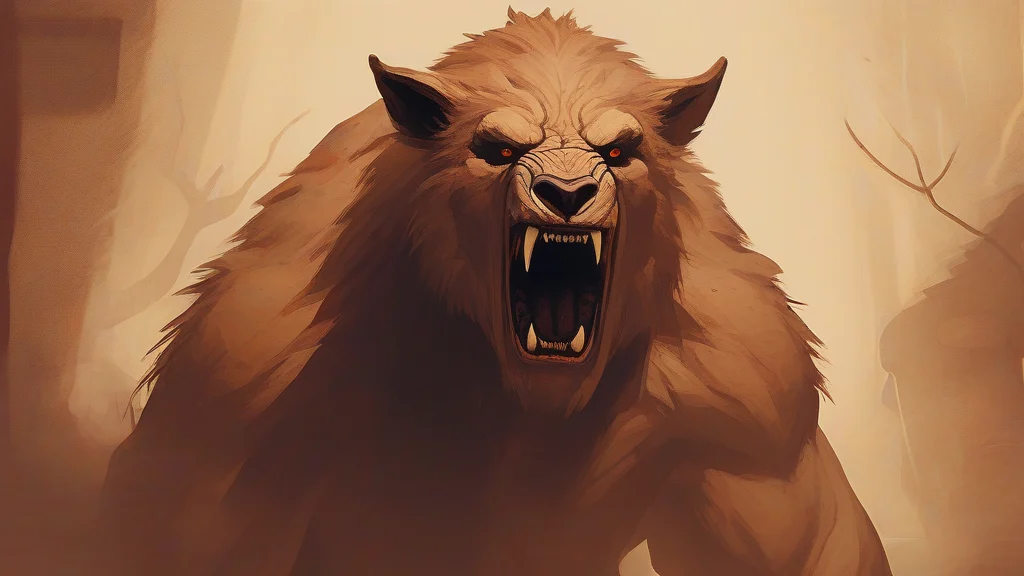
What does beast mean?
A beast is most fundamentally a large, wild, or dangerous animal, though the word extends to any non-human creature and, by extension, to people who behave with brutality or coarseness. Over time it has also acquired a strikingly positive informal sense: describing something — a machine, a challenge, an athlete — as exceptionally powerful, capable, or formidable, so that being called 'a beast' on a playing field is now a compliment rather than an insult. The word's connotations range from primal danger and savagery to awe-inspiring strength, making it highly versatile in both literal description and figurative speech. Common fixed phrases such as 'beast of burden' and 'the nature of the beast' show how deeply embedded it remains in everyday English. Derived forms include 'beastly', used to mean unpleasant, disgusting, or (in older British usage) very. With roots reaching back through Old French to Latin 'bestia', 'beast' has carried its core sense of non-human animal life across more than a thousand years of English.
A large, dangerous, or wild animal; any non-human creature.
"The villagers claimed a fearsome beast roamed the mountains at night."
Often used figuratively for a brutal person or something of great size or power.
A person who behaves in a cruel, coarse, or savage manner.
"Only a beast could treat a defenceless animal that way."
Informal: something impressively powerful, difficult, or capable, such as a machine, vehicle, task, or competitor.
"This workout is a real beast."
Modern informal register; usually admiring rather than negative.
Standard regular plural; used both literally for animals and figuratively for brutish people or formidable things.
"The savannah teemed with magnificent beasts."
In the Book of Revelation, 'the Beast' is one of the most infamous figures in Western literature — and it's why calling someone 'a beast' can be either an insult or, on sports fields today, a huge compliment.
Reviewed by Deb Chak, Editor. AI-assisted content curated by RJS Tech Solutions LLP.
Etymology of beast
Beast entered Middle English around the thirteenth century, borrowed from Old French 'beste', which derived from Latin 'bestia' meaning a wild animal. Latin 'bestia' is of uncertain deeper origin, possibly related to or influenced by 'ferus' (wild) or a pre-Latin substrate word. The same Latin root gave English 'bestial', 'bestiary', and 'bestiality', all preserving the connection to animal nature. Its core sense — a large, non-domesticated animal — has remained remarkably stable since its adoption into English.
Related word forms
How beast is actually used
In modern informal usage, especially in sports and gaming, calling someone or something 'a beast' is high praise, denoting dominance or impressive power — a notable reversal from its older sense of insult. In British English, 'beastly' as an adjective carries a mildly old-fashioned, disapproving tone. In biblical and literary contexts, 'the Beast' refers specifically to apocalyptic evil.
Easily confused with beast
'Beast' is the noun meaning an animal or savage person, while 'beastly' is the adjective (or British informal adverb) describing something disgusting or unpleasant.