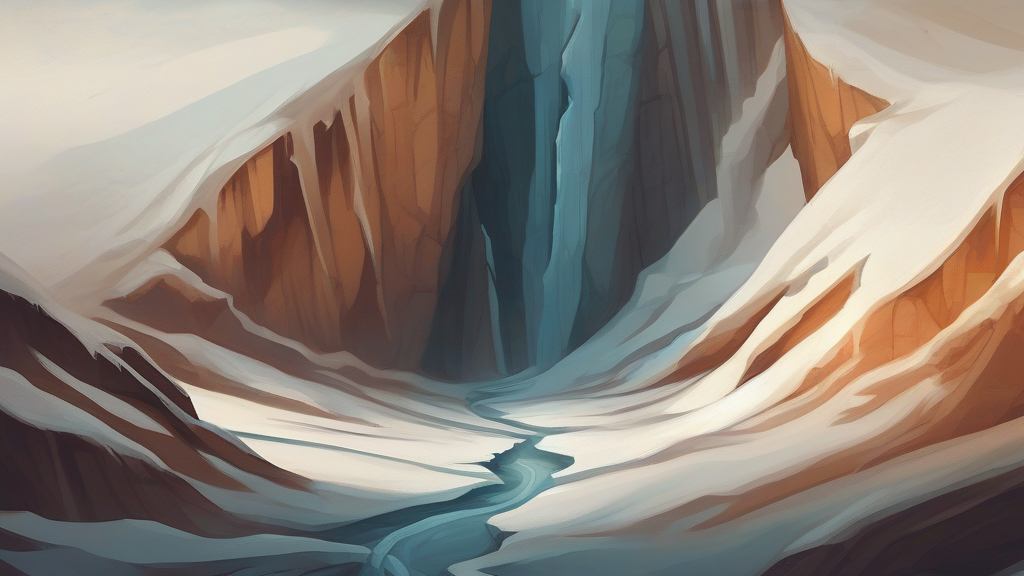
What does crevasse mean?
A crevasse is a deep, open fissure, most characteristically one that splits the surface of a glacier or ice sheet. Crevasses form as moving ice stretches and fractures, and they are among the greatest hazards faced by mountaineers and polar travellers, since drifting snow can bridge them invisibly — hence practices such as roping teams together and probing suspect ground. Beyond glaciology, the word has a specific American sense: a breach in a river levee, a usage rooted in the French-speaking culture of Louisiana and preserved in histories of catastrophic Mississippi floods. Borrowed from French in the early nineteenth century, from Old French 'crevace', ultimately related to Latin 'crepare', 'to crack or burst', the word shares ancestry with 'crevice'. Its tone is technical and serious rather than everyday; speakers generally reserve it for genuinely large, dangerous cracks, leaving smaller openings to 'crack', 'cleft', or 'crevice'.
nounA deep, open crack or fissure, especially in a glacier or ice sheet. The term is also used more broadly for any similar deep breach in an embankment, levee, or the earth's surface.
- A deep open crack in a glacier or other body of ice.
- A deep breach or break in an embankment or levee (especially in American usage regarding Mississippi River floods).
"The climbers roped themselves together before crossing the glacier, knowing that a hidden crevasse could swallow them without warning."
"Bridges of snow concealed the crevasses beneath, making the glacier crossing treacherous even for experienced mountaineers."
"When the levee crevassed during the great flood of 1927, entire parishes were submerged within hours."
Pronounced /krəˈvæsɪz/, with a voiced /z/ ending.
"The route wove between dozens of crevasses opened by the summer thaw."
The word 'crevasse' comes straight from French — and when a New Orleans levee 'crevassed' in the 19th century, it meant the floodwater had won.
Reviewed by Deb Chak, Editor. AI-assisted content curated by RJS Tech Solutions LLP.
Etymology of crevasse
Crevasse was borrowed into English in the early nineteenth century directly from French 'crevasse', meaning a rupture or breach. This derives from Old French 'crevace' ('a crack'), formed from the verb 'crever' ('to burst or break'), which descends from Latin 'crepare', 'to crack, creak, or burst'. The same Latin root gives English 'crevice' (via Old French 'crevice') and underlies 'raven'-related words such as 'crave' through different routes; 'craven' is sometimes linked to this family but its etymology is debated.
How crevasse is actually used
The word carries strong associations with mountaineering, glaciology, and polar exploration, so its figurative use is rare; writers seeking a metaphorical 'deep split' usually choose chasm or rift instead. The plural is pronounced with a /z/ sound (/krəˈvæsɪz/), matching words like 'gas'. In American English, 'crevasse' as a verb meaning 'to breach (a levee)' survives mainly in historical accounts of Mississippi River flooding.
Easily confused with crevasse
A crevice is any narrow crack or opening (often small and in rock), while a crevasse is specifically a deep, usually wide fissure, most typically in glacial ice.