What does crewelwork mean?
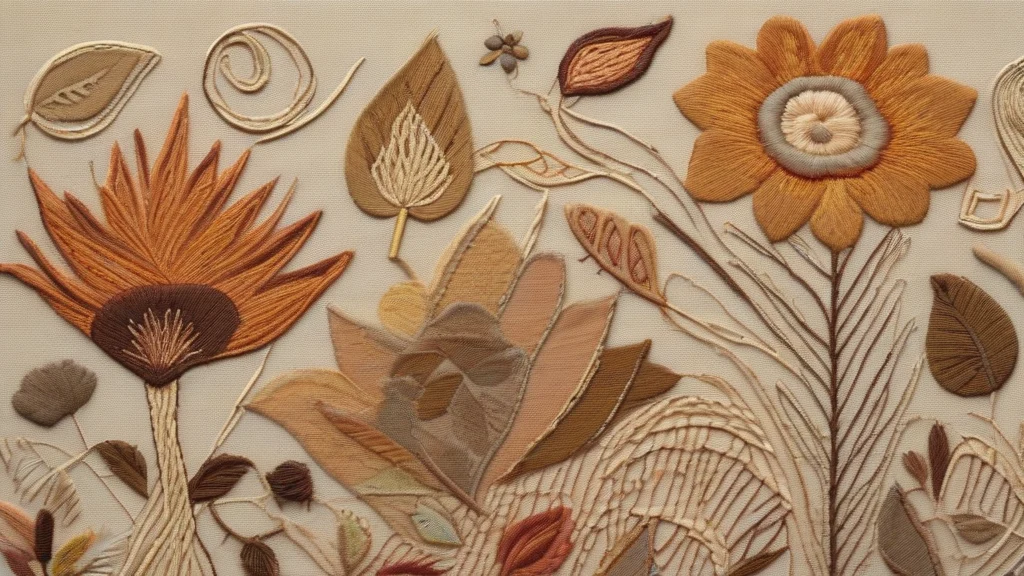
Crewelwork is a form of decorative embroidery distinguished above all by its materials: it uses crewel, a fine two-ply worsted wool yarn, stitched onto a firmly woven ground fabric such as linen. Unlike surface techniques limited to a single stitch, crewelwork embraces a wide repertoire of stitches — satin, stem, chain, long-and-short among them — allowing shaded, painterly effects. The style reached its height in seventeenth-century England, where Jacobean crewelwork featured flowing vines, exotic birds, flowers, and fantastical foliage across bed hangings, curtains, and wall panels. Today the word appears chiefly in the vocabulary of textile arts, museums, and interior decoration, evoking traditional craftsmanship and heirloom quality. Enthusiasts still practice the craft, and antique pieces are prized by collectors, keeping this distinctive word very much alive in the language of needlework.
nounEmbroidery worked in crewel wool (a fine two-ply worsted wool yarn) on a plain-woven fabric such as linen, typically using a variety of decorative stitches.
- Decorative embroidery worked in two-ply wool yarn (crewel) on linen or similar fabric, especially in flowing designs of plants, animals, and scrolling motifs.
"The Jacobean chair was upholstered in richly colored crewelwork depicting vines, birds, and flowers."
"She spent the winter working a panel of crewelwork for the living room wall."
"Museums of decorative art preserve exquisite examples of seventeenth-century English crewelwork."
Rarely pluralized; the uncountable form is standard when referring to the craft generally. A plural may occasionally appear when counting distinct individual works.
"The exhibition brought together crewelworks from several private collections."
Crewelwork adorned the grand homes of 17th-century England so lavishly that entire bed hangings and wall panels were covered in it — a single set could take years to stitch by hand.
Reviewed by Deb Chak, Editor. AI-assisted content curated by RJS Tech Solutions LLP.
Etymology of crewelwork
Crewelwork combines 'crewel', a word for a fine twisted worsted wool yarn, with 'work', in the sense of handiwork or embroidery. The origin of 'crewel' itself is uncertain: it appeared in English around the late fifteenth to sixteenth century, possibly from Welsh 'crywel' or from an unrecorded continental source, though no derivation can be stated with certainty. The compound describes the craft named for its characteristic thread, much as 'needlework' is named for its tool. Related forms include the American pastry name 'cruller', sometimes linked to the same Dutch or Germanic strand as 'crewel', though that connection remains debated.
How crewelwork is actually used
Crewelwork is a relatively formal or specialist term, used mainly in discussions of needlecraft, textiles, and decorative arts. The related term 'crewel embroidery' is often interchangeable with it; 'crewel' alone refers to the wool yarn rather than the finished work. It carries connotations of traditional craftsmanship and heritage interiors, particularly the Jacobean style of early modern England.
Easily confused with crewelwork
Cross-stitch is a specific X-shaped stitch or the embroidery made with it, whereas crewelwork is defined by its material — wool thread on linen — and may employ many different stitches.
Tapestry is a woven textile in which the design is created during weaving, while crewelwork is stitched onto an already woven ground fabric.