
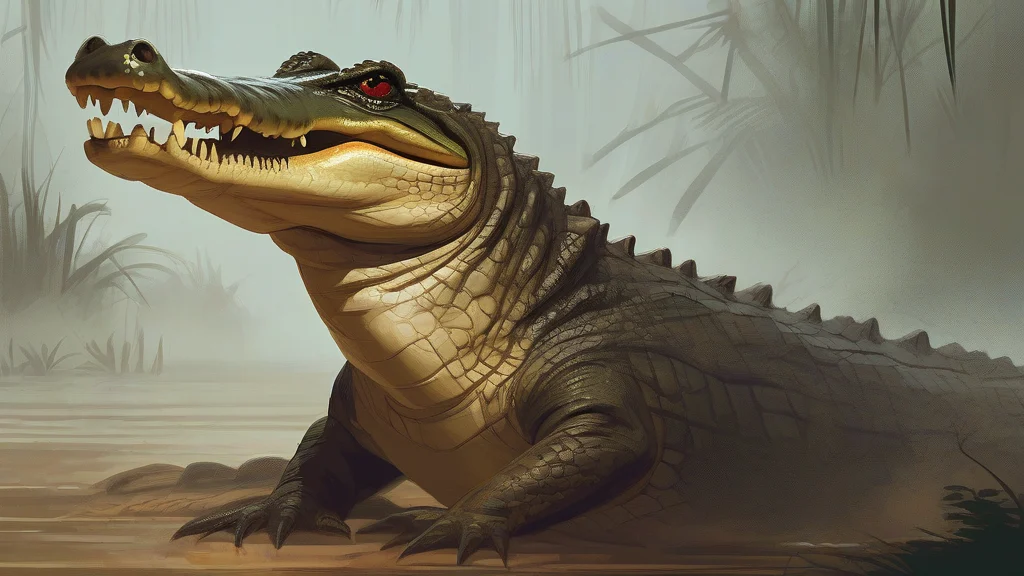
What does crocodilian mean?
A crocodilian is any member of Crocodilia, the order of large semiaquatic predatory reptiles that includes crocodiles, alligators, caimans, and gharials. These animals are characterised by elongated snouts, powerful jaws, thick armoured skin, and a semi-aquatic lifestyle, with species distributed across tropical and subtropical regions worldwide. In scientific contexts, 'crocodilian' serves as a precise umbrella term: because 'crocodile' strictly denotes only members of the family Crocodylidae, zoologists use 'crocodilian' when discussing the entire lineage. The word also functions adjectivally, as in 'crocodilian behaviour' or 'crocodilian anatomy'. Beyond biology, the term carries connotations of ancient resilience — crocodilians first appeared in the late Cretaceous period and have survived multiple mass extinctions with remarkably little morphological change. For anyone writing about herpetology, palaeontology, or wildlife conservation, 'crocodilian' is an indispensable term for accurate, unambiguous reference to this distinctive group of reptiles.
Any large predatory reptile of the order Crocodilia, including crocodiles, alligators, caimans, and gharials.
"Alligators and caimans are both types of crocodilian found in the Americas."
Preferred in scientific contexts as it encompasses all members of the order, not just true crocodiles.
Of, relating to, or characteristic of the crocodilians.
"The fossil revealed distinctly crocodilian skull features."
Used primarily in zoological and palaeontological literature.
Standard English pluralisation applies; no irregular forms exist.
"Several extinct crocodilians grew to enormous sizes during the Mesozoic era."
Crocodilians have outlived the dinosaurs, two ice ages, and every mass extinction since the Triassic — making them one of evolution's most enduring success stories.
Reviewed by Deb Chak, Editor. AI-assisted content curated by RJS Tech Solutions LLP.
Etymology of crocodilian
The word derives from 'crocodile', which entered English in the 16th century via Latin 'crocodilus' and Greek 'krokodilos', itself applied to this animal by Herodotus, possibly from a Greek corruption of an Egyptian phrase meaning 'pebble-worm' or from Gallic associations with lizard-like creatures. The suffix '-ian' was appended in modern scientific nomenclature to form a taxonomic designation for the order Crocodilia, giving 'crocodilian'. Cognates include the Latin-derived scientific name Crocodylus and the order name Crocodilia.
How crocodilian is actually used
The term is used chiefly in zoology and palaeontology; 'crocodile' alone does not cover alligators or gharials, so 'crocodilian' is preferred when referring to the whole group. Both 'crocodilian' and the alternative spelling 'crocodylian' appear in scientific literature.
Easily confused with crocodilian
'Reptilian' refers broadly to any reptile or reptile-like trait, whereas 'crocodilian' is specific to the order Crocodilia — crocodiles, alligators, caimans, and gharials.