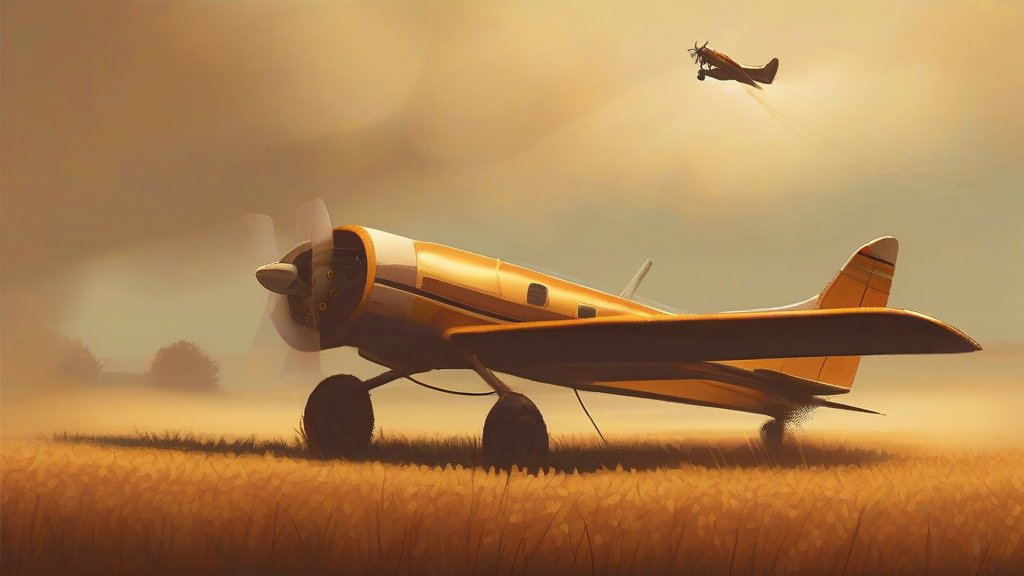
What does cropduster mean?
A cropduster is a small, agile aircraft adapted for agricultural work — chiefly the aerial application of pesticides, herbicides, fungicides, and fertilizers over farms. Fitted with tanks and spray booms, these planes typically fly just metres above fields, releasing fine mists across large areas far faster than ground equipment could manage. The term also refers by extension to the pilots who fly such missions, a profession known for demanding skill, nerve, and close attention to wind and terrain. Cropdusters are strongly associated with rural North America, where they are a familiar sight over grain belts and cotton country, though aerial spraying occurs worldwide. The word carries a distinctly practical, rural connotation rather than any technical formality, and it appears often in journalism about farming and aviation safety. Written variously as 'crop duster' or 'cropduster', it is a vivid, concrete piece of vocabulary linking aviation technology with everyday agriculture.
nounA cropduster is a small aircraft fitted with spraying equipment, used to distribute pesticides, herbicides, or fertilizer over farmland; it can also refer to the pilot who flies such an aircraft.
- A small aircraft equipped to spray pesticides or fertilizer over crops.
- The pilot who operates such an agricultural spraying aircraft.
"At first light, the cropduster swept low over the cotton fields, trailing a fine mist behind it."
"The cropduster banked sharply at the end of the field to avoid the farmhouse."
"After twenty years as a cropduster, he could read the wind off a wheat field better than any meteorologist."
The plural applies equally to multiple aircraft or multiple pilots, depending on context.
"Three cropdusters were parked along the grass strip beside the hangar."
Cropdusters must fly so low over fields that their pilots are legally exempt from some low-altitude rules that ground every other kind of aircraft.
Reviewed by Deb Chak, Editor. AI-assisted content curated by RJS Tech Solutions LLP.
Etymology of cropduster
Cropduster is an early twentieth-century English compound formed from 'crop' (the produce of cultivated fields) and 'duster' (an agent that scatters dust or powder), reflecting the earliest aerial applications of powdered insecticides such as lead arsenate over American orchards and cotton fields after the First World War. Both elements are native English words of long standing: 'crop' derives from Old English 'cropp' meaning the head or top of a plant, while 'dust' comes from Old English 'dust'. The compound is a coinage of agricultural aviation rather than a borrowing, so it has no classical cognates beyond those shared roots.
Related word forms
How cropduster is actually used
Informal to neutral in register; common in agricultural and rural American contexts. The word is used both for the aircraft itself and, by metonymy, for its pilot. 'Crop duster' is often written with a space but is frequently closed up as 'cropduster'.
Easily confused with cropduster
An airliner is a large passenger aircraft carrying people on scheduled routes, whereas a cropduster is a small agricultural aircraft that sprays chemicals over crops.