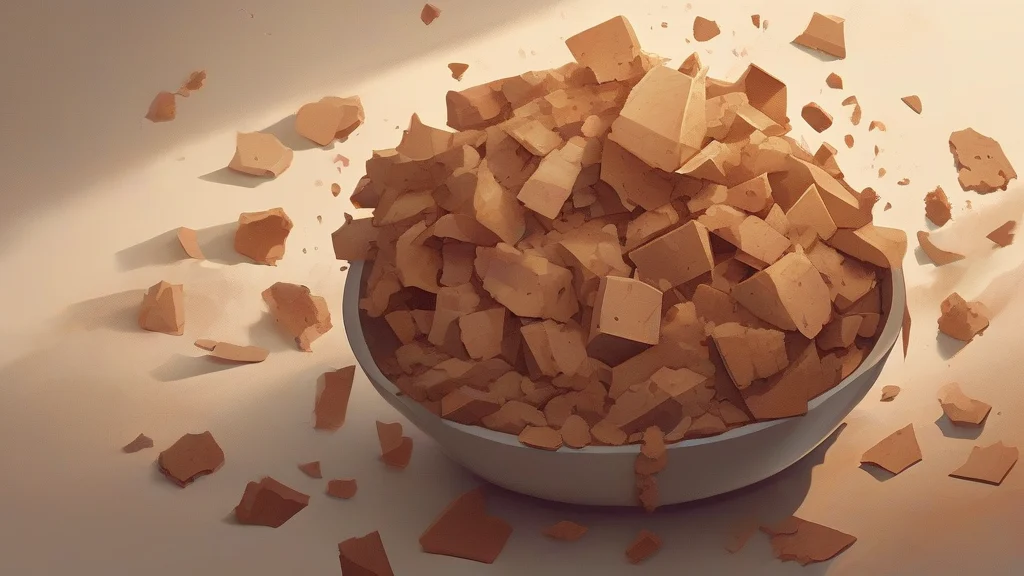
What does crumbled mean?
"Crumbled" is the past tense and past participle of the verb "crumble," meaning to break apart into small fragments or crumbs. In its literal sense, it describes foods like bread, cookies, cheese, or pastry that separate into fine particles when bitten or handled, as well as materials like brick, concrete, or stone that decay and fall away over time. Figuratively, it is one of English's most expressive words for decline: empires, economies, marriages, confidence, and carefully laid plans are all said to have crumbled, evoking an image of slow, often unstoppable deterioration rather than abrupt destruction. The word derives ultimately from "crumb," itself rooted in Old English "cruma." Its related forms — "crumble," "crumbling," and "crumbly" — share this lineage. Neutral in tone, "crumbled" suits both casual conversation and formal prose, and it frequently appears in phrases such as "crumbled to dust" and "crumbled away," which capture its connotations of impermanence and gradual loss.
verb (past simple and past participle)Past tense and past participle of "crumble": to have broken or fallen apart into small fragments or crumbs, either literally (as food or masonry) or figuratively (as an institution, confidence, or plan).
- (of food, stone, or other solid material) broken apart into crumbs or small fragments
- (figuratively) collapsed, failed, or gradually lost strength, as an empire, economy, relationship, or person's resolve
- (of baked goods) having a texture that breaks easily into loose particles
"The ancient wall had slowly crumbled under centuries of rain."
"The cookie had sat in the tin so long that it crumbled at her touch."
"After the scandal broke, his public image quickly crumbled."
The word "crumbled" carries its own origin inside it — it grew from "crumb," the Old English word for a tiny fragment of bread.
Reviewed by Deb Chak, Editor. AI-assisted content curated by RJS Tech Solutions LLP.
Etymology of crumbled
"Crumbled" comes from the verb "crumble," a frequentative formation on "crumb," meaning to break repeatedly into crumbs. "Crumb" descends from Old English "cruma," meaning a small piece or fragment, making the word thoroughly Germanic in origin. It has no classical Latin or Greek root, so true cognates lie among the Germanic languages rather than the Romance vocabulary of English. The extended sense of gradual institutional or emotional collapse developed later than the literal sense of breaking into fragments.
Related word forms
How crumbled is actually used
"Crumbled" is neutral in register and works equally well in everyday speech and formal writing. It is most vivid when used figuratively for institutions, plans, or reputations, where it suggests gradual, often inevitable collapse rather than sudden destruction.
Easily confused with crumbled
"Crumbled" means broken into small fragments or falling apart, while "crumpled" means crushed or wrinkled out of shape (as with paper or fabric).