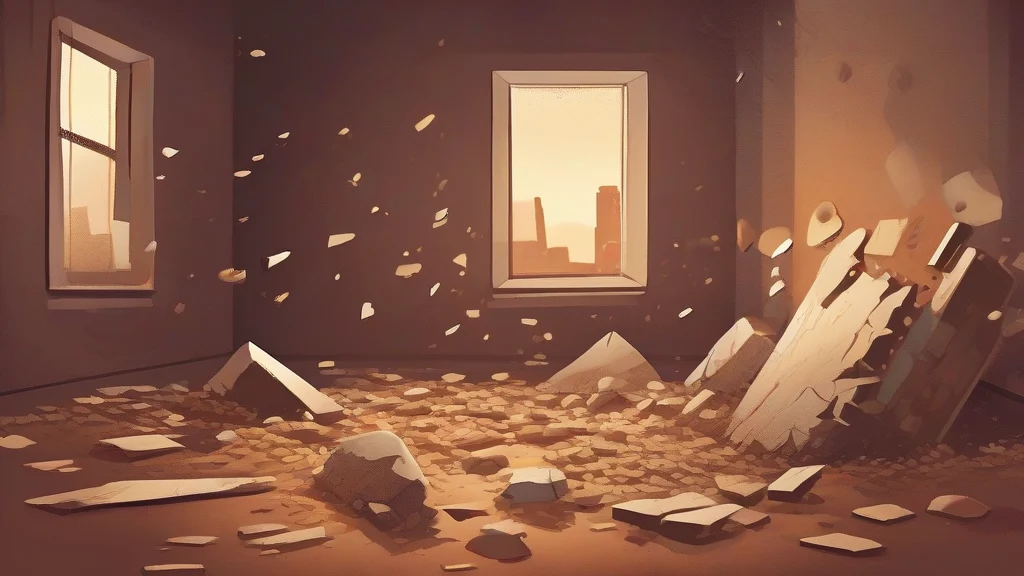
What does crumbling mean?
"Crumbling" is the present participle and gerund of the verb "crumble", describing the process of breaking apart into small fragments or crumbs. Literally, it applies to materials such as stone, brick, pastry, or old plaster that lose structural integrity over time; figuratively, it is widely used for things that decay or collapse gradually, such as crumbling infrastructure, a crumbling marriage, or a crumbling economy. The word suggests slow, progressive deterioration rather than abrupt failure, lending it a tone of melancholy inevitability that writers often exploit for rhetorical effect. Derived from "crumb", a word of Old English origin meaning a small fragment of bread, it entered English through Middle English forms associated with falling into crumbs. Both its literal and figurative senses are firmly established in contemporary British and American English, making it a versatile and evocative term for describing anything in visible or metaphorical decline.
Present participle and gerund of "crumble": to break or fall apart into small fragments or crumbs, whether literally or figuratively.
"The coastline was crumbling into the sea after years of erosion."
Frequently used figuratively for systems, relationships, and institutions undergoing gradual decline.
The action or process of breaking apart into small fragments or crumbs.
"The crumbling of the bridge's supports was first noticed during a routine inspection."
Less common than the verb form; usually appears in technical or descriptive contexts.
From a single crumb of Old English bread comes a word we now use to describe the fall of empires.
Reviewed by Deb Chak, Editor. AI-assisted content curated by RJS Tech Solutions LLP.
Etymology of crumbling
The verb "crumble" derives from "crumb", which comes from the Old English "cruma", meaning a small fragment or particle, especially of bread. The frequentative verb form developed in Middle English, likely by analogy with similar -le verbs, and came to mean breaking into small particles. Its Germanic roots connect it to cognates in other Germanic languages referring to small fragments. The participle "crumbling" has long been used both literally, for decaying structures and food, and figuratively, for institutions and ideals in decline.
Related word forms
How crumbling is actually used
"Crumbling" carries a connotation of gradual, often unstoppable decline rather than sudden destruction, which makes it a favourite word in journalism for describing ageing buildings, failing states, and deteriorating institutions. It is standard in both formal and informal registers, and the figurative sense is at least as common as the literal one in modern usage.
Easily confused with crumbling
"Crumpling" means crushing something into wrinkles or folds (like paper or fabric), while "crumbling" means breaking apart into small fragments or crumbs.