
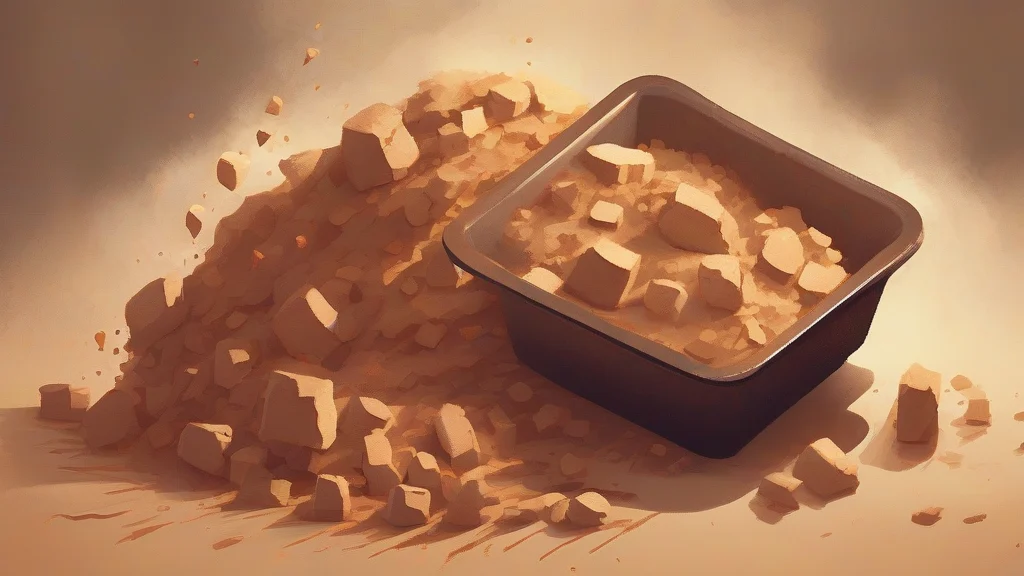
What does crumblier mean?
"Crumblier" is the comparative form of the adjective "crumbly," describing something that breaks more readily into small crumbs or loose fragments than something else. It belongs firmly to the language of food and texture: cheese, pastry, biscuits, cornbread, and cooked meats are all commonly described as being crumblier or less crumblier than an alternative. A cook might note that one shortbread recipe turns out crumblier than another because of a higher butter ratio, or that aged cheddar is crumblier than young gouda. Beyond the kitchen, the word occasionally describes soils, rocks, or other materials that disintegrate easily under pressure. The word is informal to neutral in register, with warm, appetizing connotations when applied to food — crumbliness often signals richness or quality rather than failure. Its negative counterpart appears in structural contexts, where a crumblier texture implies fragility. Related forms include the base adjective "crumbly" and the superlative "crumbliest." For anyone writing about cooking, baking, or texture, "crumblier" offers a precise, evocative way to compare how things fall apart.
adjective (comparative of crumbly)Comparative form of the adjective "crumbly": more likely to break into small crumbs or fragments; less firm or more easily crumbled than something else.
- (comparative of crumbly) Having a texture that breaks more readily into small crumbs or pieces than something else; used especially of foods such as cheese, pastry, biscuits, and bread.
"The older cheddar was far crumblier than the smooth, waxy variety we'd bought last week."
"This cornbread came out much crumblier after we swapped in buttermilk."
"The soil here is noticeably crumblier since we started adding compost each autumn."
From feta to shortbread, the tastiest things in the kitchen are often the crumblier ones — a word that literally celebrates falling apart.
Reviewed by Deb Chak, Editor. AI-assisted content curated by RJS Tech Solutions LLP.
Etymology of crumblier
The word derives from "crumbly," which in turn comes from "crumb," a noun of Old English origin (related to Old English "cruma"), meaning a small broken piece of bread or cake. The verb "crumble" developed from the same root, adding the frequentative sense of breaking repeatedly into crumbs. The comparative suffix "-er" attaches regularly to produce "crumblier," following the pattern of other adjectives ending in -y. Cognate formations appear throughout Germanic languages, reflecting a shared Germanic root for small fragments.
Related word forms
How crumblier is actually used
An informal, everyday word found almost exclusively in food writing and domestic contexts — recipes, reviews of cheese or baked goods, and casual descriptions of texture. It is the standard comparative of "crumbly," so it takes no separate dictionary headword status beyond its base adjective. Avoid using it for abstract or emotional contexts.
Easily confused with crumblier
"Crumblier" means more crumbly in texture, whereas a misspelling like "crumbier" is not a standard English word and should be avoided.