
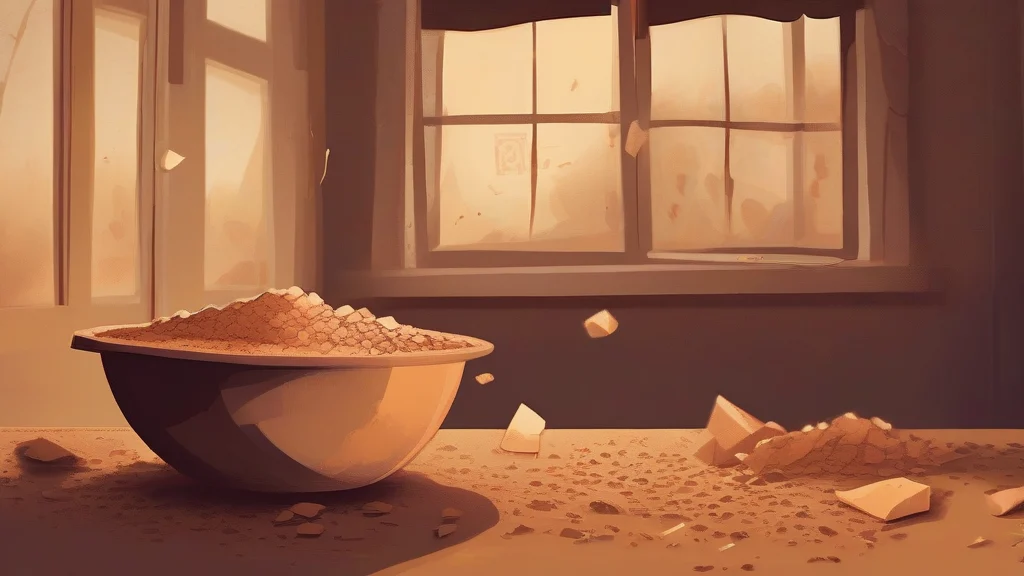
What does crumbliness mean?
Crumbliness is the quality of being crumbly — the tendency of a substance to break apart into small, loose particles or crumbs when handled, bitten, or cut. It is most commonly used to describe foods such as shortbread, scones, pastry, fudge, and certain cheeses, where the degree of crumbliness is a key marker of texture and quality: bakers speak approvingly of a biscuit that offers just the right crumbliness, neither doughy nor dry. Beyond the kitchen, the word can apply to any friable material, including soil, chalk, or decayed masonry. The term derives from the verb 'to crumble,' which traces back through Middle English to Old English 'cruma,' meaning crumb. Though simple and somewhat homespun in register, crumbliness fills a genuine lexical gap, naming precisely what more technical terms like 'friability' express in scientific language, making it a useful and vivid word for describing how things come apart.
nounThe quality or state of being crumbly; the tendency of a substance to break or fall apart into small crumbs or fragments.
- The physical property of a material, especially food, of tending to break into small crumbs rather than holding together.
"The shortbread's perfect crumbliness made it melt apart at the first bite."
"A good scone should balance tenderness with just enough crumbliness."
"The aged cheddar was prized for its dense, flaky crumbliness."
Rarely pluralized; the word is almost always treated as uncountable since it names an abstract quality. A plural would appear only in unusual technical or contrastive contexts referring to different kinds of crumbliness.
"Different cheeses display distinct crumblinesses depending on their moisture content."
Bakers chase it, cheese graders measure it, and geologists have their own name for it — friability — yet 'crumbliness' remains the homeliest word in the texture vocabulary.
Reviewed by Deb Chak, Editor. AI-assisted content curated by RJS Tech Solutions LLP.
Etymology of crumbliness
Crumbliness is formed from the verb 'crumble,' combined with the suffix '-ness,' which turns qualities into abstract nouns. The verb 'crumble' developed in English from 'crumb,' which descends from Old English 'cruma,' meaning a small broken piece of bread or other matter. As an English formation built on Germanic roots rather than a Latin borrowing, it shares its origin with related native words such as 'crumbly' and 'crumbling.'
How crumbliness is actually used
An everyday, largely informal descriptive noun most often encountered in writing about food, baking, and cookery, though it can describe any friable material such as soil or rock. It carries a generally positive connotation in culinary contexts, where controlled crumbliness signals good texture.
Easily confused with crumbliness
Crumpling is the act of crushing something into wrinkles or folds, whereas crumbliness is the inherent tendency of a substance to break into crumbs.