What does crumpet mean?
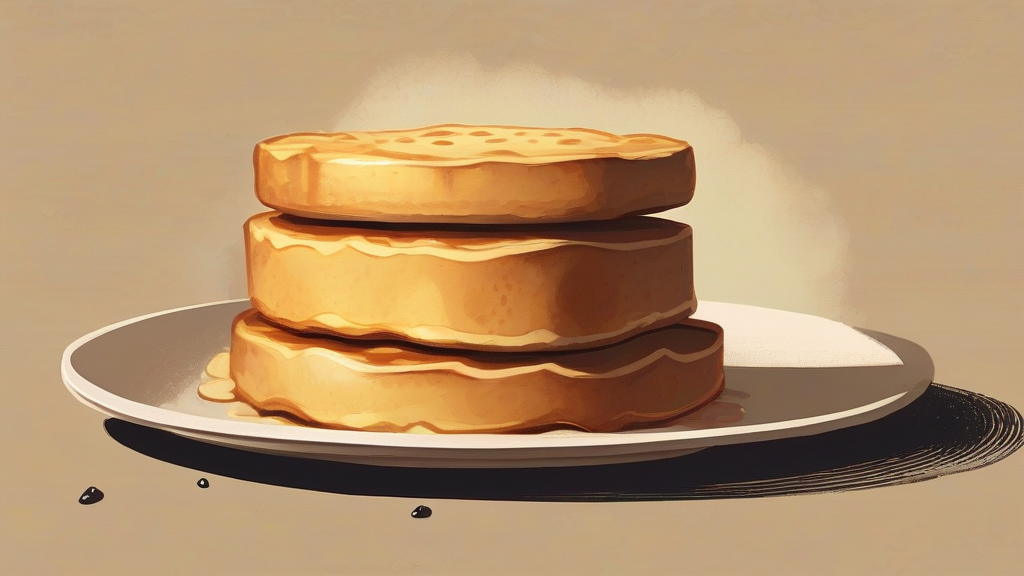
A crumpet is a small, round griddle cake made from a flour, yeast, and milk batter, cooked on a flat pan so that it develops a smooth, pale underside and a soft, spongy top riddled with holes. It is almost always eaten toasted and generously buttered, with the butter melting into the surface pores — the feature that defines it. Crumpets are a fixture of British teatime, often appearing alongside tea, jam, and toast, and they have become shorthand in popular culture for cozy, comforting Britishness. The word also has a dated British slang sense referring to a person considered physically attractive, as in the phrase 'a bit of crumpet', though this usage now sounds old-fashioned and mildly cheeky. Closely related items include the English muffin, which is split before toasting, and the pikelet, a regional name for a thinner variant. For anyone exploring British food culture or vocabulary, crumpet is a warm, evocative staple worth knowing precisely.
A round yeast-leavened griddle cake with a smooth base and a porous, holey top, traditionally toasted and buttered at teatime.
"A plate of hot crumpets was set out beside the teapot."
Almost always used in the plural when referring to the food being served; singular 'a crumpet' refers to one individual cake.
(British, informal, dated) A person regarded as sexually attractive, especially in the phrase 'a bit of crumpet'.
"The tabloids of the era cheerfully described the new starlet as 'a bit of crumpet'."
This slang sense is now largely outdated and may be perceived as objectifying; use with caution in contemporary writing.
Standard pluralization; crumpets are usually served in multiples, so the plural is more common in everyday speech than the singular.
"Would you like another crumpet, or shall I finish off the last two?"
Those holes aren't a flaw — they're the entire point: a crumpet's cratered top exists purely to trap melting butter.
Reviewed by Deb Chak, Editor. AI-assisted content curated by RJS Tech Solutions LLP.
Etymology of crumpet
Crumpet first appears in English in the late 17th century, when it was likely a thin, flat pancake rather than today's yeasted griddle cake. Its origin is uncertain but commonly linked to Welsh crempog, meaning a pancake or griddle cake, or possibly to Old French crespe/crepe, both ultimately connected to the idea of a curled or crinkled batter cake. The familiar holey, yeasted form developed during the Victorian era. The slang sense arose separately in 20th-century British English, playing on the food's association with comfort and indulgence.
How crumpet is actually used
The word carries strong associations with British teatime culture and is often used metonymically for cozy domesticity. The slang sense ('a bit of crumpet') is dated and mildly risqué, mostly found in mid-20th-century British usage. 'Pikelet' is a regional (especially Australian/Northern English) variant name for a thinner or sweeter version.
Easily confused with crumpet
An English muffin is a similar yeast-raised griddle bread but is split open before toasting and has a coarser texture, whereas a crumpet is toasted whole with its distinctive holey top intact.
A strumpet is an archaic word for a promiscuous woman and shares only a superficial sound resemblance with the food item crumpet.