
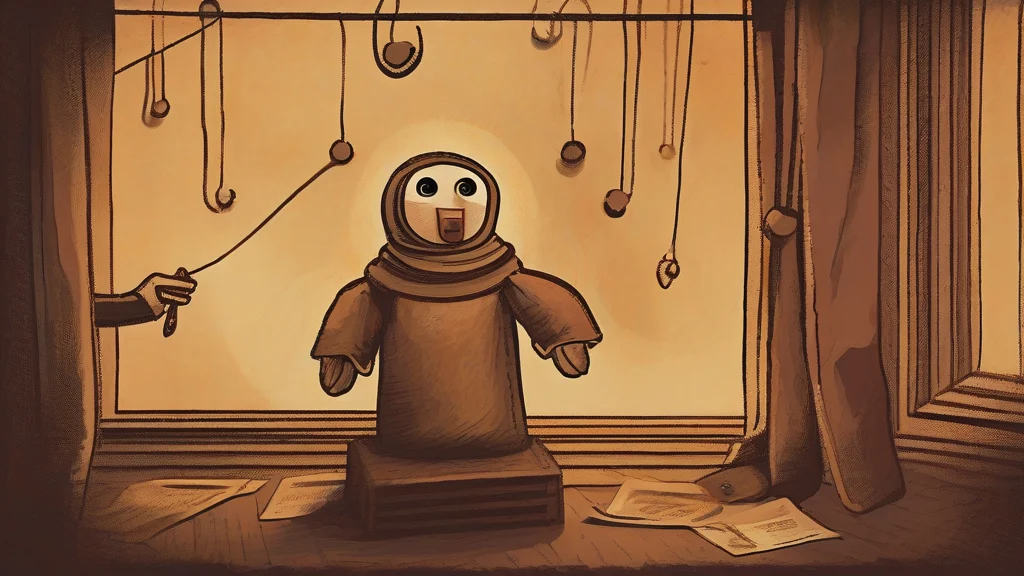
What does puppet mean?
A puppet is a figure or character brought to life by a performer’s physical movements. Some are suspended from strings, others are fitted around the performer’s hands, and many represent recognizable people, animals, or imaginary beings. The word also has a serious figurative use: calling someone a puppet implies that their choices, reputation, or public actions are controlled by a more powerful individual or organization. In politics, the term often suggests that an apparent leader lacks genuine independence. As a verb, “to puppet” names the act of directing or manipulating another person’s conduct. Because the word combines a concrete object with a vivid metaphor of human control, it works effectively in both storytelling and political criticism.
A figure, toy, or character representing a person or animal that is moved by strings, rods, or a performer’s hands; by extension, a person controlled by another.
"A bird puppet appeared above the curtain."
The figurative sense is usually derogatory or strongly critical when applied to an actual person.
To control or manipulate another person’s actions, decisions, or public conduct.
"The organization denied that it was trying to puppet its political allies."
This is a relatively uncommon transitive verb and is especially common in political and journalistic discussion.
Use “puppets” for multiple figures or for multiple people described as being controlled by others.
"The two puppets recited the verses while the puppeteer spoke through them."
A puppet can be a playful character on a small stage or a sharp metaphor for anyone whose choices are controlled by a more powerful person.
Reviewed by Deb Chak, Editor. AI-assisted content curated by RJS Tech Solutions LLP.
Where does puppet come from?
The word entered Middle English in the form “popet,” borrowed from Old French popet, a diminutive related to Latin pupa, meaning “doll.” English later developed the spelling “puppet,” and modern forms such as “puppetry” and “puppeteer” continued the native word family. Latin pupa also underlies the biological term “pupa,” while the older English word “poppet” and French poupée reflect the same ancient root.
Related word forms
How puppet is actually used
As a noun, “puppet” can be affectionate when referring to a toy figure or a child’s pretend character, but it is usually critical when describing a person under someone else’s control. The verb “to puppet” is less common and generally informal, especially in political usage.
Easily confused with puppet
A puppet is the figure or character being manipulated, whereas a puppeteer is the person who controls and performs the puppet.
A marionette is a puppet suspended from and controlled by strings, while “puppet” also includes figures moved by a performer’s hands.