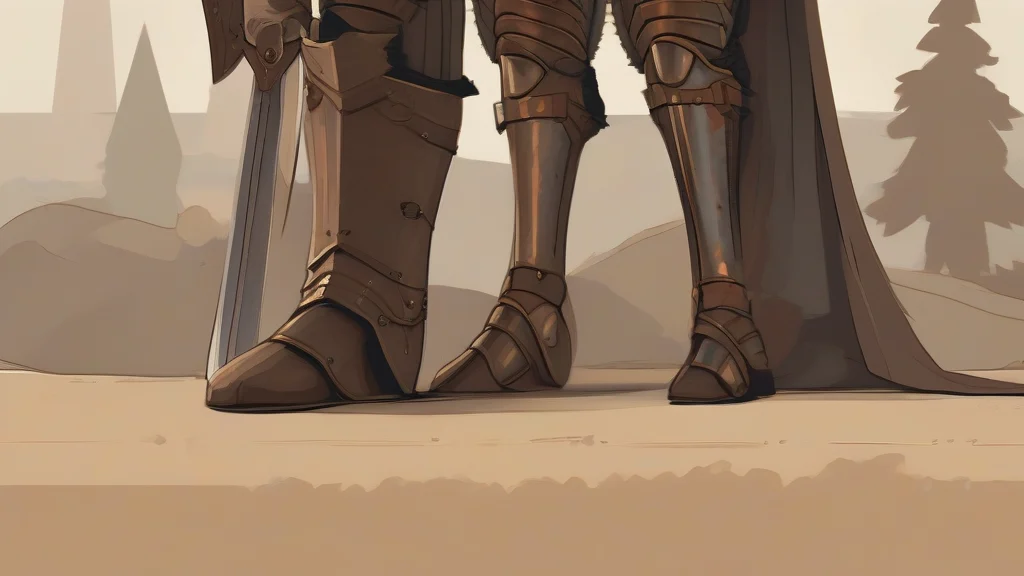
What does cuisse mean?
A cuisse is a component of plate armour designed to protect the thigh. Worn by knights and men-at-arms in medieval and Renaissance Europe, cuisses were typically made of shaped steel plates, often articulated so they could flex with the wearer's leg during riding or combat. They usually worked together with neighbouring pieces — the poleyn at the knee and the greave on the lower leg — forming an integrated defence for the entire limb, and were frequently secured over a foundation of mail chausses. The word entered English from French, where 'cuisse' means simply 'thigh', reflecting the practical habit of naming each armoured plate after the body part it covered. Today the term survives mainly in specialised contexts: museum catalogues, histories of arms and armour, heraldic terminology, and the vocabulary of reenactment and collecting communities. For anyone studying medieval warfare or historic costume, it is one of the standard technical terms for understanding how a full harness protected the body.
nounA cuisse is a piece of plate armour that protects the thigh, worn as part of a full suit of armour and typically paired with a poleyn guarding the knee.
- A piece of plate armour protecting the thigh, especially in medieval and Renaissance European armour.
"The knight's articulated cuisses gleamed beneath his surcoat as he mounted his horse."
"The museum's display featured a Milanese suit whose cuisses were fluted to deflect blows."
"Each cuisse was strapped over the mail chausses to protect the thigh in mounted combat."
The standard plural follows normal English rules; because thigh armour is worn in pairs, the plural is more common than the singular in practice.
"Both cuisses show evidence of having been resized for a later owner."
The word 'cuisse' is just the ordinary French word for 'thigh' — medieval armourers simply named each plate after the body part it covered.
Reviewed by Deb Chak, Editor. AI-assisted content curated by RJS Tech Solutions LLP.
Etymology of cuisse
'Cuisse' comes directly from the Old French word for thigh, which developed from the Latin 'coxa', meaning hip or thigh. English borrowed the French armourers' term during the medieval period, alongside related pieces of the harness such as the poleyn and greave. The same Latin root gives modern anatomy its 'coxal' terminology for the hip bone.
How cuisse is actually used
Cuisse is a specialist term used almost exclusively in discussions of historical arms and armour, heraldry, and museum or reenactment contexts; it does not appear in everyday speech. It is normally used in the plural when describing a full pair of leg defences.
Easily confused with cuisse
Despite a superficial resemblance, 'cruiser' is a warship or police vehicle, while a cuisse is a piece of thigh armour.