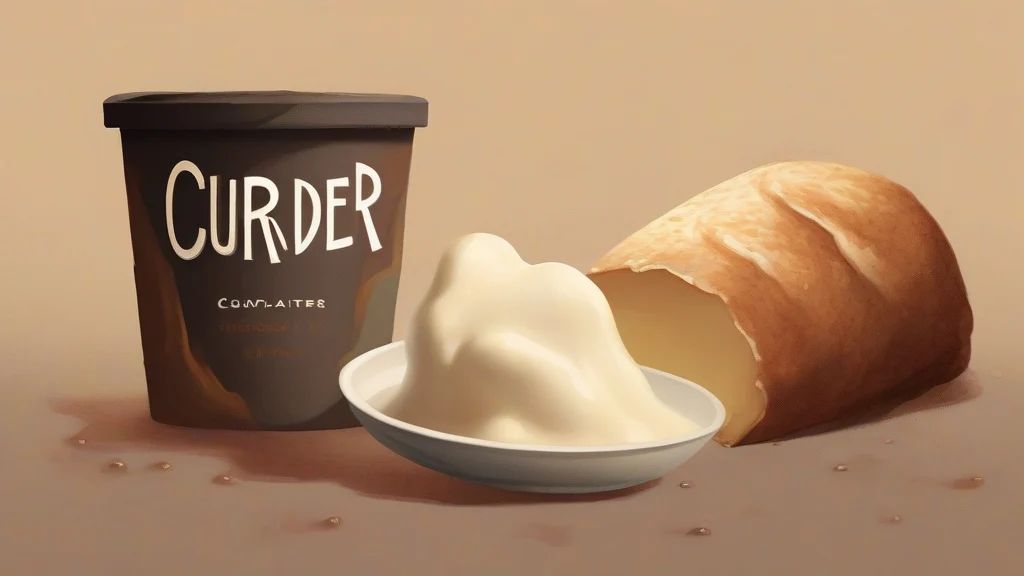
What does curdier mean?
"Curdier" is the comparative form of "curdy," an adjective describing something that resembles curd — the lumpy, clotted solid that forms when milk sours or is deliberately coagulated, as in cheese-making. To call one thing curdier than another is to say it has more of that grainy, separated, slightly lumpy quality, whether literally in dairy products or figuratively in sauces, batters, or other mixtures that have broken or congealed unattractively. The word belongs mostly to culinary and food-science description, appearing in cookbooks, product reviews, and everyday complaints about over-heated custards or split soups rather than in general prose. Its connotations are mildly negative, since curdling usually signals spoilage or a cooking mishap, though in cheesemaking a well-formed curd is desirable. Because it derives from the familiar noun "curd," its meaning is transparent even to readers meeting it for the first time.
adjective (comparative form)Comparative form of "curdy": more like curd in appearance or texture — lumpy, clotted, or coagulated in the way that curdled milk is.
- Resembling curd; having the lumpy, clotted texture of curdled milk (comparative degree).
"Left too long in the heat, the sauce grew even curdier than before."
"The custard broke in the oven, turning curdier with every passing minute."
"He frowned at the curdier patches floating on top of his soup."
Reviewed by Deb Chak, Editor. AI-assisted content curated by RJS Tech Solutions LLP.
Etymology of curdier
"Curdier" is formed by regular inflection from "curdy," an adjective built on the noun "curd." The noun "curd" has been in English since the Middle English period, though its ultimate origin is uncertain — it may be related to the dialect word "crud," which carries much the same meaning. The verb "curdle" arose later as a frequentative-style derivative of "curd." Beyond this core group, no secure cognates in other languages can be stated with confidence.
Related word forms
How curdier is actually used
Rare outside technical or descriptive writing about food, dairy, and cooking failures; almost always used predicatively or comparatively rather than attributively.
Easily confused with curdier
"Curdled" describes milk or a liquid that has actually turned to curds, while "curdier" is simply a comparison meaning something looks or feels more like curd.