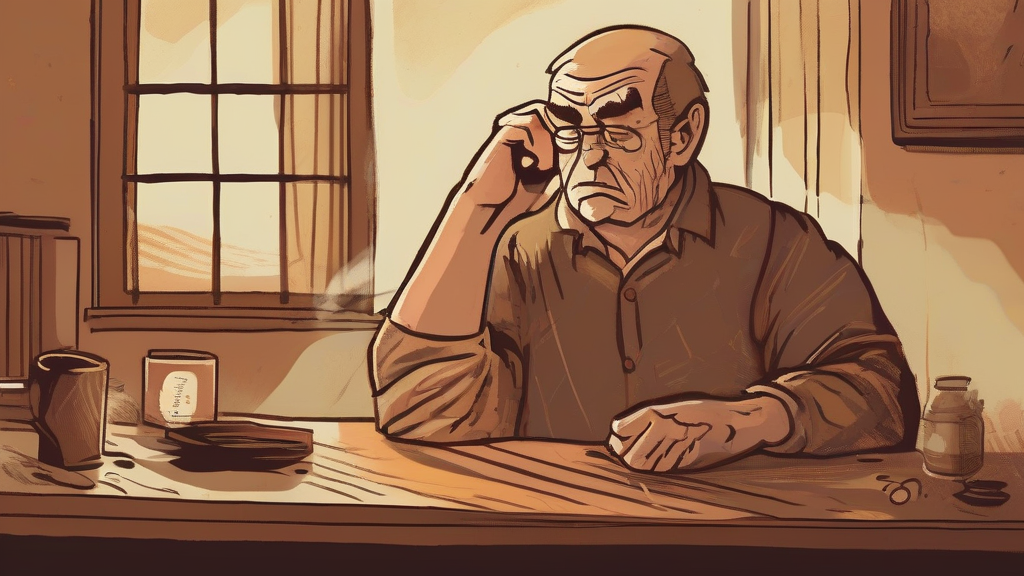
What does curmudgeon mean?
A curmudgeon is a bad-tempered, irritable person — typically an older individual who complains frequently, resists change, and greets the world with habitual grumpiness. The word carries strong connotations of surliness and fault-finding, yet its tone is rarely cruel: in everyday usage, calling someone a curmudgeon is often more affectionate than insulting, suggesting a familiar, almost endearing grouchiness. Phrases like 'lovable curmudgeon' capture this warmth, and the word appears regularly in journalism, fiction, and casual conversation to characterize anyone from a grumbling grandfather to a cynical columnist. Derived forms include 'curmudgeonly,' used as an adjective to describe gruff or irritable behavior. The word's origins remain genuinely obscure — even eighteenth-century lexicographer Samuel Johnson confessed uncertainty about its etymology — which adds to its charm. For writers, 'curmudgeon' offers a precise, colorful alternative to bland terms like 'grump,' conveying both irritation and a certain crusty dignity.
nounA bad-tempered, surly person, especially one who is habitually grumpy and critical of others; often an older man set in his ways.
- A bad-tempered, grumpy, or cantankerous person, especially an elderly man.
- (Extended/affectionate) A person who is stubbornly old-fashioned or resistant to change, sometimes with a hint of fondness rather than pure criticism.
"The old curmudgeon shouted at the children to get off his lawn."
"The office curmudgeon complained about the new open-plan layout for weeks."
"Despite his gruff exterior, the town's resident curmudgeon secretly left anonymous donations to the local shelter."
Standard regular plural; no irregularities.
"Two curmudgeons sat grumbling on the park bench."
Nobody knows where 'curmudgeon' comes from — even Samuel Johnson admitted defeat, guessing wildly that it meant someone with an 'unkind heart.'
Reviewed by Deb Chak, Editor. AI-assisted content curated by RJS Tech Solutions LLP.
Etymology of curmudgeon
Curmudgeon first appeared in English in the late sixteenth century, but its origin remains one of lexicography's genuine mysteries. Samuel Johnson famously admitted he could not determine its derivation, offering only a speculative folk etymology. Various theories have connected it to French 'curmudgeon'-like forms or Scottish sources, but none has been proven conclusively. The adjective 'curmudgeonly' developed later from the noun.
Related word forms
How curmudgeon is actually used
Informal to mildly formal register; common in journalism and everyday speech. Often used affectionately or humorously ('lovable curmudgeon') rather than as a harsh insult. Frequently applied to older men, though it can describe anyone of any age or gender.
Easily confused with curmudgeon
A churl is a rude or ill-mannered person (historically a peasant), whereas a curmudgeon is specifically a bad-tempered, miserly, or grumbling person.