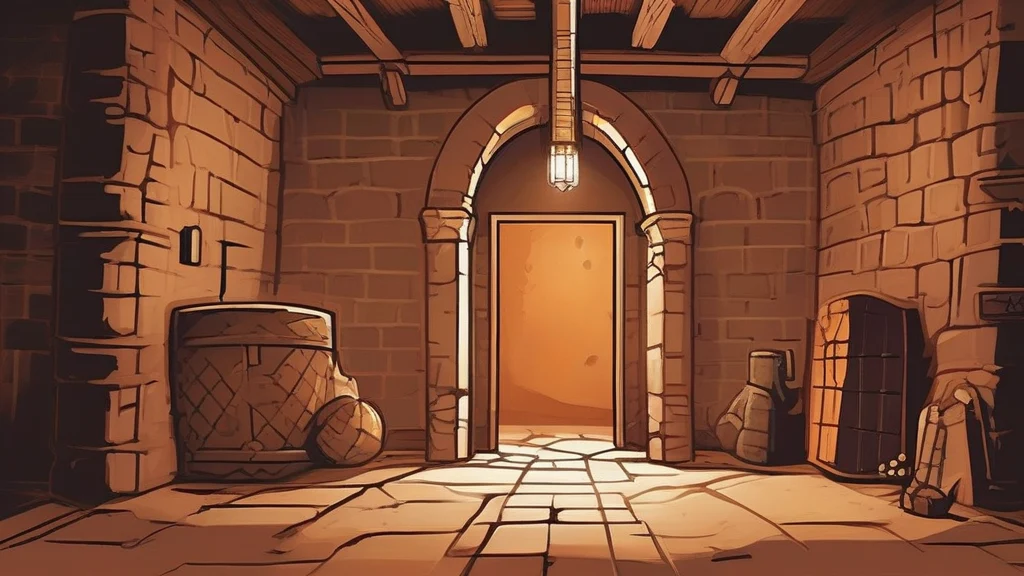
What does dungeon mean?
A dungeon is a dark, underground room or cell, most famously those found beneath medieval castles, where prisoners were confined, often in grim conditions. Historically, dungeons served as places of imprisonment and interrogation, and they have become powerful symbols of oppression, secrecy, and suffering in literature and popular culture. Beyond its literal sense, the word is frequently applied figuratively to any unpleasantly dark, damp, or cramped space — an office basement might be jokingly called a dungeon. The word also carries strong associations with fantasy gaming, where the 'dungeon' is a stock setting for adventure, and where a 'dungeon master' guides players through invented worlds. Derived ultimately from Latin dominus ('lord'), via Old French donjon meaning a castle's main tower, the word is a striking example of how a term for a fortress's strongest point came to name its darkest space. It remains common in both historical writing and everyday metaphor.
nounA dark underground room or cell, especially in a castle, used historically as a prison. More broadly, any grim, confined, dungeon-like space.
- An underground prison cell, especially one in a medieval castle.
- A dark, gloomy, confined underground room or space (often figurative).
"The prisoners were held in the castle's dungeon for months without trial."
"Legend says the king kept his rivals chained in the dungeon beneath the great tower."
"The basement felt like a dungeon: damp, windowless, and lit by a single bare bulb."
Standard plural; countable noun.
"Medieval castles often had several dungeons hidden beneath their towers."
The word 'dungeon' and the castle keep it hides beneath come from the same Latin root as 'dominion' — the lord's strongest tower literally ruled over everything, including the cells at its base.
Reviewed by Deb Chak, Editor. AI-assisted content curated by RJS Tech Solutions LLP.
Etymology of dungeon
Dungeon comes from the Latin dominus, meaning 'lord' or 'master', which gave Old French donjon — the term for a castle's main fortified tower, or keep. When the word passed into Middle English, it came to refer to the underground prison cells typically located within or beneath that stronghold. English thus acquired two forms of what was originally the same word: 'donjon', preserving the architectural sense of the keep, and 'dungeon', preserving the prison sense. Cognates trace back to the same Latin root that yields words like 'dominion', 'dominate', and 'danger'.
How dungeon is actually used
Mostly associated with medieval castles and fantasy settings; in modern usage it often appears figuratively to describe any unpleasant, dark, cramped space. The phrase 'dungeon master' has a distinct specialized meaning in role-playing games such as Dungeons & Dragons.
Easily confused with dungeon
A donjon is the fortified main tower or keep of a medieval castle — the word from which 'dungeon' derives — while a dungeon is an underground prison cell; the two words are historical doublets.