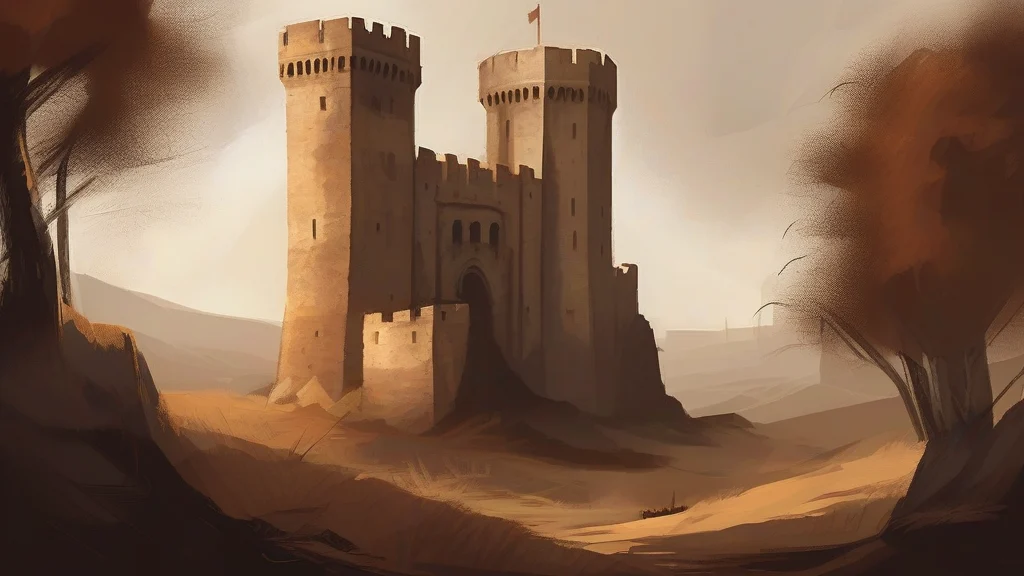
What does donjon mean?
A donjon is the great tower or keep at the heart of a medieval castle — its tallest, strongest, and most defensible structure. Unlike the outer walls and gatehouses that might be stormed or breached, the donjon served as the final refuge for the garrison, and it frequently housed the lord's private quarters, great hall, and storerooms. The word comes from Old French and ultimately traces back to Latin terms connected with lordship and power, reflecting the tower's role as the seat of a castle's master. In English it has a curious doublet: the closely related word "dungeon," which once meant much the same thing, drifted over time to mean an underground prison cell — so the fortress's crowning tower gave rise to the name of its darkest imagined chamber. Today "donjon" appears mainly in historical writing, archaeology, and fantasy literature; in ordinary conversation most speakers would simply say "keep." Its evocative sound and romantic associations make it a favourite among authors seeking authentic medieval atmosphere.
nounThe main tower or keep of a medieval castle, typically the strongest and most defensible structure at its heart, used as a last refuge and often as the lord's residence.
- The great tower or keep of a medieval castle, serving as its strongest point of defence and last refuge.
"From the battlements of the donjon, the garrison could watch every approach to the castle."
"Visitors climbed the spiral stair of the donjon for a panoramic view of the surrounding countryside."
"When the outer walls were breached, the defenders withdrew into the donjon and held out for another week."
The plural is regular and is used mainly when discussing several castles or architectural surveys.
"Norman donjons across England vary widely in size and design."
The dungeon you imagine beneath the castle was originally the donjon towering above it — same word, opposite ends of the building.
Reviewed by Deb Chak, Editor. AI-assisted content curated by RJS Tech Solutions LLP.
Etymology of donjon
"Donjon" entered Middle English from Old French "donjon," the term for a castle's great tower, which itself developed from Vulgar Latin forms derived from Latin "dominium," meaning lordship or mastery — a nod to the tower as the lord's seat of power. The word's history in English produced a remarkable doublet: "dungeon," borrowed through Anglo-Norman, gradually shifted in sense from the lord's tower to a dark prison cell, while "donjon" retained the original architectural meaning. Related words from the same Latin root include "dominion" and "dominant," all pointing back to the idea of lordly authority.
How donjon is actually used
"Donjon" is a technical and literary term, used chiefly by historians, archaeologists, and writers about medieval architecture; in everyday speech "keep" is far more common. It carries a somewhat elevated, antiquarian register.
Easily confused with donjon
A dungeon is an underground prison cell, whereas a donjon is the great central tower of a castle; the two words share an origin but diverged in meaning.