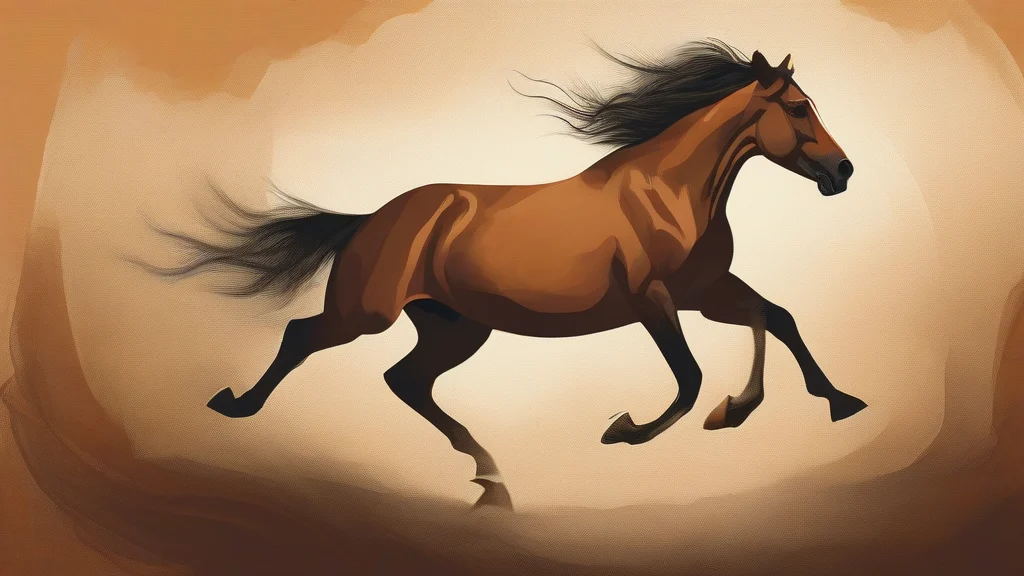
What does curveting mean?
Curveting describes the spirited leaping movement of a horse that springs forward on its hind legs, kicks out behind, and lands on both forefeet together — a caper that signals high spirits rather than disobedience. The word comes from the present participle of the verb 'curvet' and may also be used as a noun for the movement itself. Beyond the stable, it can describe any playful bounding or frisking motion, though such use is rare today. Curveting appears most often in equestrian writing, hunt reports, and descriptive prose, where it lends a vivid, slightly old-fashioned elegance to accounts of horses at liberty. It sits comfortably alongside synonyms like prancing, capering, and gambolling, all words that celebrate exuberant animal motion. For anyone writing about horses, curveting offers a precise term for one of the most joyful things a horse can do.
(Of a horse) to make a series of lively leaps with the hind legs kicked out and the forelegs landing together; more generally, to bound or caper playfully.
"The young stallion kept curveting whenever the hounds drew near."
Usually encountered as the present participle 'curveting'; the base verb is 'curvet.'
A single leap or bound of a horse in which the hindquarters are thrown upward and the hind legs extended backward, the animal alighting on both forelegs together.
"Each curveting carried the pony higher than the last."
As a standalone countable noun, 'curvet' is more common than 'curveting'; 'curveting' as a noun typically refers to the ongoing action.
When a horse 'curvets,' it isn't misbehaving — it's showing off, kicking its heels up in a leap that dressage riders spend years trying to perfect.
Reviewed by Deb Chak, Editor. AI-assisted content curated by RJS Tech Solutions LLP.
Etymology of curveting
Curveting derives from the verb 'curvet,' which entered English from French 'courvette' (a derivative related to 'courber,' meaning to bend), ultimately tracing back to Latin 'curvus,' meaning curved or bent. The image behind the word is of the horse's arched, bent frame mid-leap. It has been used in English since at least the early modern period, appearing in riding manuals and literary descriptions of horses. Its cognates include other English words descended from 'curvus,' such as curve and curvature.
Related word forms
How curveting is actually used
Chiefly used of horses and found mainly in equestrian, literary, and hunting contexts; it carries a connotation of exuberance and high spirits rather than unruliness. The simple verb is 'curvet'; 'curveting' is its present participle and gerund, though it can also function as a verbal noun describing the movement itself.
Easily confused with curveting
'Currying' means grooming a horse with a currycomb, whereas 'curveting' describes a horse's lively leaping or bounding movement.