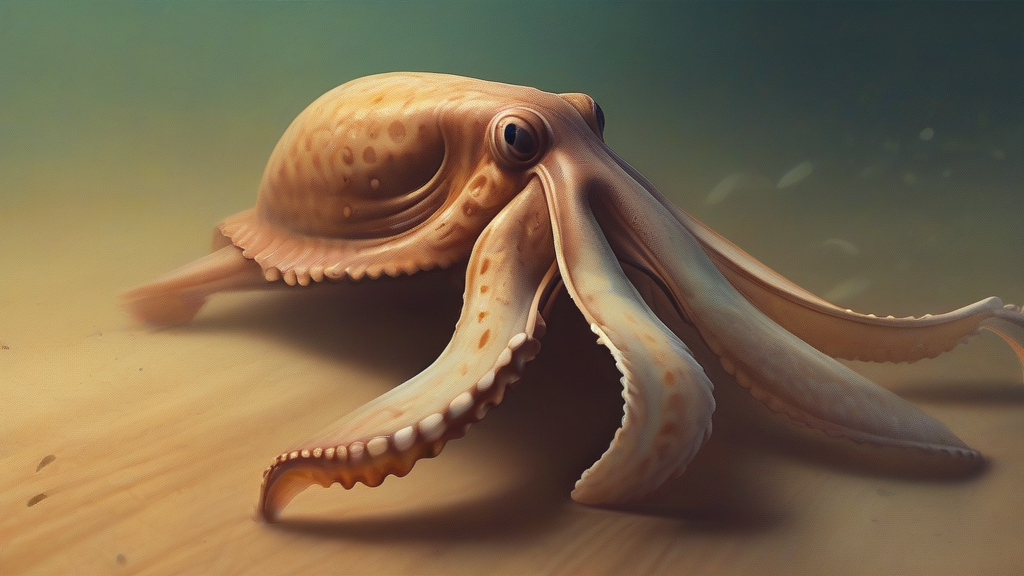
What does cuttlefish mean?
The cuttlefish is a marine mollusc belonging to the order Sepiida, making it a close relative of the squid and the octopus. Despite the name, it is emphatically not a fish: it is a cephalopod with a broad, flattened body, eight short arms, two elongated feeding tentacles, and a porous internal shell called the cuttlebone, which is often sold in pet shops as calcium for caged birds. Cuttlefish are celebrated for their extraordinary mastery of disguise — although they are believed to be colour-blind, they can transform their skin into a living screen of rapidly changing colours, patterns, and textures, using it both to hide from predators and to signal to one another. The word also appears at the dinner table: cuttlefish is eaten across the Mediterranean and East Asia, and its dark ink has long been used to flavour and colour dishes such as risotto nero. The standard plural is 'cuttlefish', though 'cuttlefishes' is equally acceptable.
A marine cephalopod mollusc of the order Sepiida, having a broad flattened body, eight arms, two tentacles, and an internal shell (the cuttlebone), renowned for its rapid changes of colour and texture.
"Divers watched the cuttlefish melt seamlessly into the coral behind it."
The edible flesh of this animal, used in Mediterranean and Asian cooking.
"She simmered the cuttlefish slowly in its own ink until the sauce turned deep black."
Both plurals are accepted; 'cuttlefish' treats the name like 'fish' and is the more common form, while 'cuttlefishes' is preferred by some dictionaries and style guides.
"Several cuttlefish gathered in the shallow water at dusk."
Cuttlefish are colour-blind — yet they are among the most dazzling masters of camouflage in the animal kingdom, painting their skin in shifting waves of colour they cannot even see.
Reviewed by Deb Chak, Editor. AI-assisted content curated by RJS Tech Solutions LLP.
Etymology of cuttlefish
The name 'cuttlefish' combines 'cuttle' with 'fish'. The element 'cuttle' descends from Old English 'cudele' (or 'cudle'), a word for this very animal whose deeper origins remain uncertain, and the compound has been in continuous use since early medieval English. The '-fish' part reflects an old habit of naming aquatic creatures generically rather than taxonomically — hence the misleading name for what is really a mollusc. The related term 'cuttlebone' simply pairs that same root with 'bone'.
How cuttlefish is actually used
The plural is commonly 'cuttlefish' (treating it like 'fish'), though 'cuttlefishes' is also correct and preferred by some dictionaries. The word appears in both scientific and everyday contexts, from marine biology writing to restaurant menus.
Easily confused with cuttlefish
Squid are fast-swimming cephalopods with torpedo-shaped bodies and stiff internal pens, whereas cuttlefish have broad, flattened bodies and a porous internal cuttlebone.
An octopus has a rounded body with eight arms and no internal shell, while a cuttlefish has eight arms plus two feeding tentacles and an internal bone.