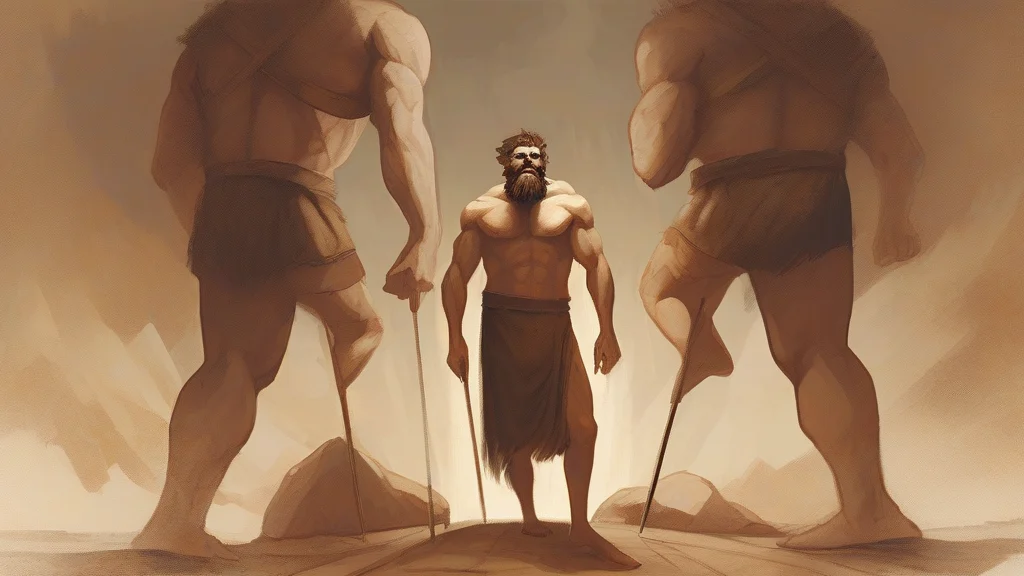
What does cyclopes mean?
Cyclopes refers primarily to the race of one-eyed giants from Greek mythology. In Hesiod's account they are three divine craftsmen — Brontes, Steropes, and Arges — who forged Zeus's thunderbolts and were credited with building mighty walls, while in Homer's Odyssey they appear as lawless, cave-dwelling herders, the most famous being Polyphemus, whom Odysseus blinds to escape his cave. The name derives from Greek 'Kyklopes', conventionally explained as 'wheel-eyed' or 'circle-eyed', from kyklos (circle) plus ops (eye). Separately, Cyclopes serves as the scientific genus name for the silky anteaters, small nocturnal mammals of Central and South American forests. In modern usage the word appears chiefly in classical studies, mythology retellings, literature on ancient art and architecture, and natural history. It carries strong connotations of monstrous power and primitive savagery when applied mythologically, yet also of craftsmanship when evoking the divine smiths.
(plural only, in mythology) The race of one-eyed giant smiths or shepherds of Greek legend.
"Odysseus and his men were trapped in the cave of Polyphemus, the most notorious of the Cyclopes."
Always treated as a proper collective noun; typically capitalized.
(taxonomy, capitalized as a genus) A genus of small, nocturnal, tree-dwelling anteaters found in Central and South America, commonly known as silky anteaters.
"Naturalists have recently split Cyclopes into several distinct species based on genetic evidence."
'Cyclopes' is itself the plural form; its singular is 'Cyclops'. Do not attempt to pluralize it further.
"A single Cyclops guarded the entrance, but the whole race was known as the Cyclopes."
The same word names both the thunderbolt-forging giants of Greek myth and a tiny, nocturnal, silk-furred anteater that fits in your palm.
Reviewed by Deb Chak, Editor. AI-assisted content curated by RJS Tech Solutions LLP.
Etymology of cyclopes
The word comes from Latin Cyclopes, borrowed directly from Greek Kyklopes (Κύκλωπες), meaning 'circle-eyed' or 'round-eyed', formed from kyklos ('circle, wheel') and ops ('eye'). The Greeks themselves offered varying explanations of the name — some deriving it from the giants' single round eye, others from the idea of a wheel-shaped mark placed on their foreheads. The Latinized form passed into English during the Renaissance revival of classical learning, alongside the adjective cyclopean, which came to describe massive masonry built of enormous unhewn blocks. The related singular form Cyclops entered English through Latin from the same Greek root.
Related word forms
How cyclopes is actually used
When used of the mythological beings, 'Cyclopes' is always capitalized and treated as a proper noun-like collective term; lowercase 'cyclopes' would be unusual except in loose retellings. The taxonomic use follows binomial nomenclature conventions, where 'Cyclopes' must be capitalized as a genus name. The word is almost exclusively encountered in classical literature, mythology references, academic writing about antiquity, or natural-history texts.
Easily confused with cyclopes
'Cyclops' is the singular form naming one one-eyed giant, while 'Cyclopes' is the plural referring to the race or group as a whole.